
Am I my brother’s keeper? Cain threw that question back at God, and Fr. Jacob Gruber, Joseph’s younger brother and a priest of the Diocese of Pittsburgh, says the answer is yes. Joseph isn’t so sure. The two brothers read Genesis 4:8–10 together and wrestle with what keeping really means: tilling and keeping in the garden, control and codependence, and the resounding yes St. John Paul II gives to Cain’s question.
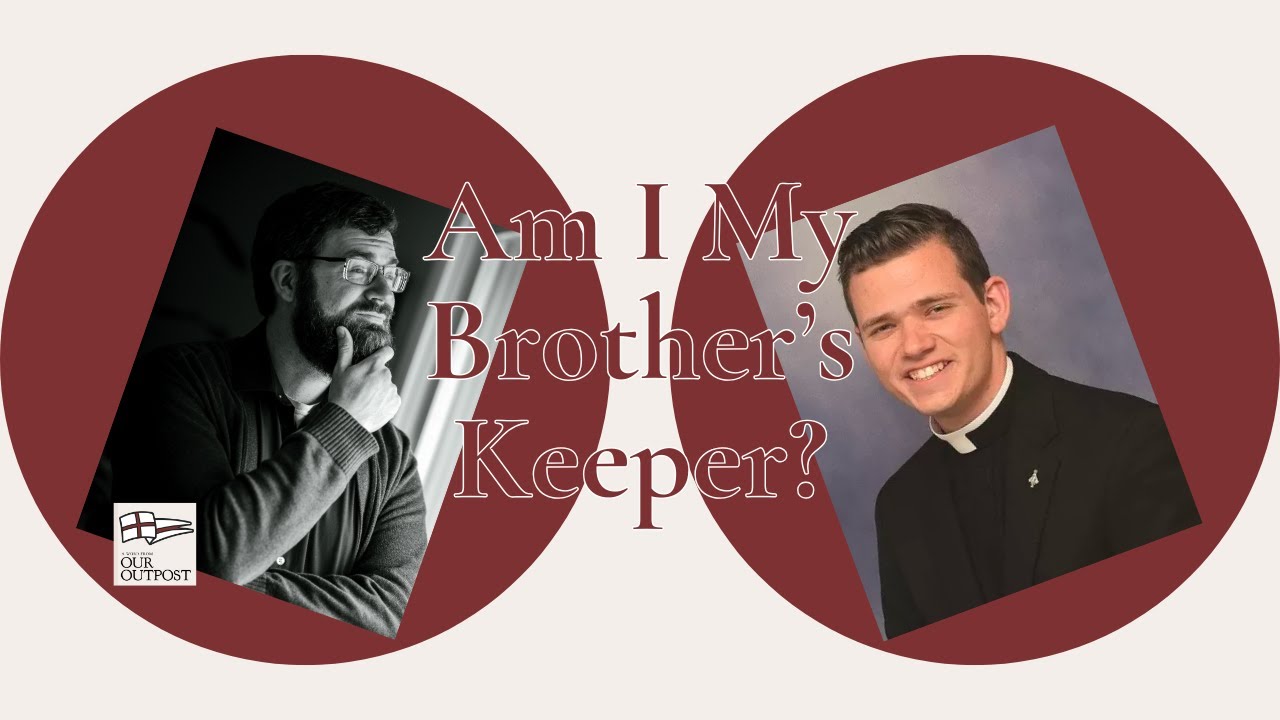
Episode 210 · 43 min · With Joseph Gruber and Fr. Jacob Gruber
Am I My Brother’s Keeper? w/ Fr. Jacob Gruber
Take the Our Outpost Quiz
A free four-minute self-assessment for Catholic couples and singles. Tell us who you are, answer a few questions, and get personalized results emailed to you, with at least one way we at Our Outpost can help you answer the call of matrimony.
Take the Quiz →Key takeaways on my brother’s keeper
- Cain threw away what God wanted to give him. When his sacrifice wasn’t accepted, Cain couldn’t handle it, and by killing his brother he destroyed the very possibility of receiving the good God intended. We can do the same when we’re angry with God and walk away before he can act.
- Keeping is the word to watch. Adam was given two tasks in the garden, to till and to keep. After the fall the tilling was cursed, and Cain the tiller was never given the keeping of animals that belonged to Abel the shepherd.
- We aren’t meant to keep people like sheep. A shepherd encloses, controls and can even dispose of what he keeps. Treating a brother that way slides toward codependence and violates the dignity of a person with an interior life.
- Yet we are all really responsible for all. The Church gives a resounding yes to Cain’s question: we are called to will the genuine good and flourishing of the person God puts in front of us. That is the root of solidarity and charity.
- Only Christ can truly keep his brother. From Cain to Joseph’s brothers in Egypt, the Old Testament is full of failures to keep a brother. Christ, the Good Shepherd, keeps us without diminishing our humanity and teaches us to till, creating the conditions for others to flourish.
“We are all really responsible for all.”
St. John Paul II, Sollicitudo Rei Socialis 38
Sit with this in prayer
Two questions to bring to the Lord this week.
Where am I trying to control someone I love instead of helping them flourish?
Whose good is the Lord asking me to will right now?
Chapters
- 0:00 Opening prayer and welcome
- 0:42 Fr. Jacob comes to visit
- 2:04 Reading Genesis 4:8–10
- 3:05 Children of Eden
- 4:51 Cain’s self-sabotage
- 8:55 Where is your brother?
- 11:24 The first brothers
- 11:55 To till and to keep
- 13:55 Shades of the prodigal son
- 15:03 Keeping people like animals?
- 18:01 Where were Adam and Eve?
- 19:57 Throwing it back in God’s face
- 23:24 What does it mean to keep a brother?
- 24:14 Ephesians and willing the good
- 30:06 Tilling, not killing
- 32:25 We are all really responsible for all
- 36:30 Christ, the brother who keeps us
- 41:20 Closing prayer
Mentioned in this episode
- Genesis 4:8–10, Genesis 2:15, Ephesians 5 and Luke 15
- St. John Paul II, Sollicitudo Rei Socialis, no. 38
- St. John Paul II, Evangelium Vitae, on Cain and Abel
- Karol Wojtyła (St. John Paul II), Love and Responsibility
- The Our Outpost Quiz, four minutes for Catholic couples and singles
Full transcript
Opening prayer and welcome
0:00 Hey, Joseph. In the name of the Father, and of the Son, and of the Holy Spirit. Amen. Direct, O Lord, our actions by Thy holy inspiration, and carry them on by Thy gracious assistance, that every word and work of ours may begin in Thee, and by Thee be happily ended.
Amen. In the name of the Father, and of the Son, and of the Holy Spirit. Amen. Hello, Father Jacob. Hello, Joseph. And hello, dear listener. Thank you so much for tuning in.
Fr. Jacob comes to visit
0:42 Hi, listeners. I’m Father Jacob. I have done episodes in the past with Joseph. I am his younger brother. I am a priest of the Diocese of Pittsburgh, and I am here visiting him for just a couple of days. I’ll be getting going tomorrow.
And so we wanted to tackle a question that seemed apropos based on our relationship with one another. Well, it in two ways, because it relates to brotherhood and whether we need to keep each other as the scriptures talk about, but also like you want this podcast to be things that people might want to talk about.
And this was something that we got really going on earlier. So maybe an interesting thing to talk about. I assume that our listeners are going to be like us and be excited about the topic. I am certain they will be like us. Yes.
Hopeful. Hopeful. If you just read the part of the scriptures that is going to lead us into it, your listeners will remember, the ones who are most loyal will remember times entering deeply into Genesis with you. So this will be a moment of coming home.
And otherwise, if you haven’t heard that, we’re going into Genesis chapter four, verses eight to 10. Why not go deeply into Genesis? That’s what I always say. Actually true. Yeah. That’s why I said it. So we’re just going to read Genesis as a whole.
So good. The first few chapters of Genesis so much. Chapter four. So rich. And so we’re going to have to be constrained for the purpose of this particular episode to just a handful of verses.
Reading Genesis 4:8–10
2:04 So beginning with, with verse eight. So the sacrifice has already been accepted by God from Abel, but not accepted from Cain. God has already had a conversation with him. And so we continue with verse eight, Cain said to Abel, his brother, let us go out to the field.
And when they were in the field, Cain rose up against his brother, Abel, and killed him. Then the Lord said to Cain, where is Abel your brother? He said, I do not know, am I my brother’s keeper? And the Lord said, what have you done?
The voice of your brother’s blood is crying to me from the ground. We’ll just stop there. Let’s do it. So some context, Genesis chapter one and chapter two, you get two different creation narratives. Chapter three, you have a moment of life in the garden.
You have the fall Genesis chapter four, we’re entering into life after the garden. We’re ending into a life that, you know, God is still there. God is still close. Very clearly there.
Children of Eden
3:05 Did you ever see Children of Eden? Yes. I was in Children of Eden in high school. I watched it. I went. You went. Awesome. I, it’s, it’s really a poignant criticism of a lot of religious faith, but I love it. There’s a lot of good to it.
A lot of their contention is that God kind of abandoned us, like that we have failed him and we disappointed him and we as humans have to come together and sort of like create meaning in a world post God because God is such a mean jerk who didn’t know how to make us very well to begin with.
I mean, do you remember that? Oh yeah. Oh yeah. When I was in it in high school, I didn’t pick up on any of that. Oh yeah. The opening song is something like I’m so lonely, I better create people so I’m not so lonely.
Yeah. Yeah. Okay. But that’s not the God of the scriptures. You don’t get that reading Genesis, you get that though, you get that when you hear people talking about Genesis poorly. True. It matters too, because it comes into this.
You would expect if there was ever a time that God would leave because he’s too annoyed with us, it would be the first time we mess up. Like why would he wait until the second or third and in the first time that we mess up, he had an opportunity to simply give up on us and every page after these first, you know, few chapters shows that God does not give up on us.
So if children of Eden is somebody’s experience of God, ridiculous. But also as God is ongoing, you know, it’s so relating with us, he wants us to be relating with him well.
And so both Cain and Abel make a sacrifice, different sacrifices and lots of reasons to wonder why God would accept one and not the other, but the other place of not acceptance is Cain, right?
Cain’s self-sabotage
4:51 Cain cannot handle the fact that God did not accept a sacrifice. And I think this happens a lot in life. There are times when we are upset with how God chooses to treat us or allows things to happen in our lives. And that doesn’t have to be the final word.
Like we believe that God has a bigger plan, a bigger picture, unless we leave before God can do that. Right? I mean, God can only do these good things in our lives if we stick around for him to do that. And the tragedy here is you could imagine God saying, just hold off one moment.
You can almost see a world in which God doesn’t give Cain the thing he wants to get. I mean, you have a few kids, I think. I do have a few. You ever have to say no to them, but you know, like you’re going to make them happy like you actually care about their wellbeing.
Has that happened to you ever? It’s happened that I’ve needed them to pause and wait so that they can actually receive the thing and then they don’t. So that… And then they destroy the actual possibility of reception. That is so wild that that has happened at one or two times in this journey of having kids.
Only a few times. Do they, by the way that they ask for something, by the way that they approach, totally destroy the possibility of receiving the thing that they desire. Only a few times. So wild. Yeah.
Funny that you were able to ask me about that in such a way that could evoke that answer because it was so unpredictable. Having had no idea that that could even have been there, we start gold, a little bit. A little bit. The tragedy here is, of course, that’s what he did.
He threw away the possibility. Go ahead. He does throw away the possibility in the most riotously bad way possible by killing his brother. He just pushes himself way out from being able to receive anything that God is trying to give him.
So you see in the conversation with God prior to the verses that he’s trying to counsel him and that Cain shrugs it all off and decides to just push everything away. So he’s not able to receive from God. He’s not capable of giving to God.
What is his due? But the reason, Father Jacob, that we pressed record was not to talk about the sacrificial. Isn’t that wild? No, but not the sacrificial part, but just that like the self-sabotage. Oh, self-sabotage. That we will do sometimes because we don’t trust.
Oh yeah. It sets up this moment, and I know our topic is a little different, but just he self-sabotages when God could have done something incredible. I didn’t realize I was as upset about this as I am.
I didn’t realize until you started, prior to pressing record, ladies and gentlemen, my brother, Father Jacob said, we’re going to keep this a short episode. We’re going to focus on these verses and this question. And then I watched, I watched as he developed themes that we explicitly…
Next episode is going to be titled, Am I My Brother’s Timekeeper? Oh, I see what you did there. You like it? No. I didn’t think you would. This is incredible. We will move on to the brother’s keeper thing, but like we do that.
I self-sabotage sometimes because I’m mad at God, and then I wonder why my life is difficult when I have destroyed the very possibility for him to give me the good thing he had intended all along. Wild. Wild. Okay. I’m burying the lead here.
I understand. Yes. God… Now that we’re on page six in section D. Page six, metaphorically, section D, metaphorically, the proverbial section D on page six. I don’t know. I love it. And I’m just giving context here. It’s all context. Referencing newspaper layouts right now is anachronistic, I feel.
So I apologize. Yeah. Because I didn’t actually know what you were doing, but yes, and I run with it. Section A, D, C, D, in a newspaper newspaper, and then page six of section D. Now who is throwing out other themes? Okay.
Where is your brother?
8:55 So God asks the question that you never want to hear, which is a question he already knows the answer to because you know something’s up. Where is your brother Abel? God knows everything. It’s kind of like when Adam is in the garden. Where are you?
Where are you? Yeah. That’s clearly playing off of what’s going on prior in the garden. Where are you now? Where is your brother? Where’s your brother? So that that’s clearly what’s going on and Cain’s response. I do not know, am I my brother’s keeper?
Also there are some echoes of the complete idiocy of lying to God, you know, Adam lies to God. Because I heard your voice and I hid because I was naked and afraid. He wasn’t even naked. This bothers me a lot. What? They made clothes for themselves out of leaves.
They weren’t even naked, right? Like he comes up with a rationale. It’s like when St. Peter’s on the boat in John 21 and the Greek word is like scantily clad. Like he might be naked and he might be like almost naked. And yet like we don’t know.
We just know that when he jumped in the water, it’s a lot like that. No, it’s not. It’s not like that. That’s not my point. So my point is the next part, the next part, which is when you were at our nephew’s baptism and you said, am I my brother’s keeper definitively?
Yes, we are our brother’s keeper. I did say that. And I wanted to push back at this because I don’t want to defend Cain. I don’t. That is not the point of this podcast. That’s not the point of the marriage ministry that my wife and I run.
I am not. I’m getting villain energy. There’s a little bit of villain energy. Go for it. I want to hear it. Because I think what he’s bringing up is both an outpouring of extreme bitterness, but also a perplexing question about our relationship one to another that does not get answered in that text.
Like God doesn’t respond to his question with an answer and Cain doesn’t respond either. Right? A dynamic is set up afterward in the way of the curse, but neither of them have an answer to the question, am I my brother’s keeper? Right. So he goes on, you know, where is your brother?
Where is Abel, your brother? I do not know my brother’s keeper. And the Lord said, what have you done? The voice of your brother’s blood. It’s not answered.
The first brothers
11:24 And also to be fair, there were never brothers before this. These are the first brothers. These are brothers. There were no brothers before the Cain and Abel were the first time in ever history that there were brothers. So like, it’s an open question.
Who knows what brothers have to do for each other. It’s not settled. But that’s not the word that I want to seize upon. And I didn’t tell you this before we pressed record, so it would stay fresh.
To till and to keep
11:55 The word keeper is so important for understanding the whole logic of this story, because when Adam was placed in the garden, he was placed with two tasks, to till and to keep, to till the earth and to keep the animals. That’s what he was tasked with.
And after the fall, what is cursed is the tilling. The tilling is what is cursed. Are you with me so far? I’m here. Okay. Okay. Yes. The tilling is what is cursed.
And then this mind bending thing that happens in the next generation is we don’t have Cain a tiller and keeper and Abel a tiller and a keeper. We have Cain who is a tiller and Abel who is a keeper of sheep, right? So Abel is a keeper of sheep and Cain is a tiller of the ground.
And Cain is tasked with the job that was cursed post fall. He was tasked. So I know you’re shaking your head like, but let this develop. Let this breathe out. We’re not on the sacrifice part.
We are on the, the life that he had been living was one where he was more intensely experiencing curse because thorns and thistles were being produced as he was trying to grow. Now again, we’re not getting into the sacrifice, the sacrifice part.
We’re getting into the part where he is confronted with the problems of original sin, maybe more so than Abel. And he is not tasked with keeping animals. That is not something that Adam delegated to him. So it’s not am I, my brother’s keeper.
I’m not the keeper of anything. I am not the keeper of anything. Do you know what I’m getting?
Shades of the prodigal son
13:55 I’m getting like glimpses here of the story of the prodigal son. I mean, you have the guy that works in thorns and thistles, you know, my whole life I have slaved the way for you father, you know, I mean, and that’s, that’s the experience of one brother who has felt that he got the short end of the stick and the other brother has received the lamb and you have never even given me a goat.
You’ve never even given me a goat. So there is a sense of like, which is why Genesis is incredible because this is, this is the quintessential moment of reflection on brotherhood, on, on relations with humans one to another. I mean, so it’s, it’s important.
No doubt about it. It’s important. It is important in the prodigal son story too, because how do we deal with somebody that we are close to near to related to whatever who has received something better than us? And that is one of the questions.
And how do we deal with the fact that we have not been tasked with that kind of responsibility? Like you can’t say your job was to keep animals and you didn’t keep your brother. Well, no, he wasn’t tasked with keeping animals at all. Right.
Keeping people like animals?
15:03 And he were, there is this question, like, how much do we, do we think of other people as mere animals, right? Like as, as a shepherd, I am responsible for knowing where each sheep is as an independent or relatively independent individual, which I know is a more modern concept being read anachronistically back into Genesis.
I get that. As someone who is an adult, I also have to allow a certain amount of independence to the other humans around me, but I don’t get to control where they go. I am not in charge of their comings and goings. I’m not in charge of enclosing them.
And this is, I think one of the things that makes the idea of being my brother’s keeper disquieting to me, because if you read it in an animalistic sense, which is how Cain seems to be reading it, he’s the one who voices the question, right?
Like where is the word keep coming from? It’s coming from the keeping of animals is I cannot comprehend the other person totally. I cannot enclose them. I cannot control them. And I think there is a legitimate way of understanding this question of am I my brother’s keeper?
In the sense of am I to keep track of them as I would an animal? No. And I think there is that sense that is flowing from a life where he knew what keeping was for an animal and he knew that that was not what he was to do.
Now, yes, he also just murdered the guy. He yes, he is bloody from the murder. Yes, he has offended God and man. Yes, he is about who killed who. Right.
But this question, this very rich question of am I my brother’s keeper, I think sometimes we abstract it too much from the text and to read it in light of what’s going on in the text, which is keeping is what you do to animals.
It is a particular role that he never got to experience and in a certain sense cannot experience with in relation to another person. So he’s asking a nonsensical question in a certain sense.
In a way, in a way, in as much as there’s the animalistic overtone, yes, I think that there’s a kind of keeping that somebody who is responsible for somebody, a guardian, a parent. So that, that. And I don’t know that it would be fair to say that that’s not included here.
Just because that word can be used for keeping animals doesn’t mean that it doesn’t have that sense. Am I, am I, am I responsible for him? Am I my child’s keeper is a different sort of question. There’s a different relationship. Okay, there we go.
So it’s like, it’s not the animalistic part per se, it’s, it’s, am I, am I over this person in a way? Do I have a responsibility? Right.
Where were Adam and Eve?
18:01 And you could say that parents do. And that’s an interesting thing here because in the story of Cain and Abel, after Adam and Eve conceive Cain and Abel, they are absent until Abel’s death and Cain’s curse. It’s only after that, that Adam and Eve come back together and say, you know, we need another child to replace Abel.
So they have Seth. And so their absence, I find really striking because they are the keepers of Cain and Abel. They are the ones entrusted with Cain and Abel. And so this is like a continuation of the fall and their dereliction of duty.
I think that’s true. It’s the breakdown of the family and they were sorry, I imagine, but they’re still. I mean, I, in a relatively recent episode, I talk about how they do repent.
We do see signs of that in the text at the end of chapter four, that they begin to call upon the name of the Lord by the end of chapter four, but they don’t do that.
They actually presume upon the Lord at the beginning of chapter four and Adam knew his wife Eve and Eve conceived and bore a child Cain and said, I have purchased this child from God. Right. They presume upon God in the beginning and they call upon God by the end.
But I think there’s this notion of, am I my brother’s keeper? This is putting a weight on brothers that really should be felt more so by Adam and Eve, by the parents. I do think that’s poignant because there are keepers involved who are not keeping.
And I don’t know how old they are. They’re clearly old enough to be doing this kind of labor, but there’s a kind of keeping that either didn’t happen at the right time or didn’t happen earlier when it would have been necessary when you raise your children.
Throwing it back in God’s face
19:57 I also would point out that there’s just a real bitterness to that answer in the narrative because knowing that he just did that deed, it’s, you know, I mean, this is what he chose to spit back at God. Where is your brother, Abel?
He could have just said, I don’t know. And that would have been partially true in a way. Because in a certain sense, what happens to a man after he’s died? This is the first time somebody died. Yeah, so so there are all sorts of firsts happening here and they’re not excellent.
But besides that, like, I think that when he says, am I my brother’s keeper? He’s throwing back into the face of God his own plans. It’s almost like he believes that God, by asking where Abel was, is saying you had the responsibility to know where he is, probably to not kill him, but to know where he is and he’s, he’s undercutting the whole institution of brotherhood.
Well, I mean, he’s, he’s presenting a kind of maximal case. Like, are you saying that I have total responsibility for my brother? Right? Like, I don’t know if you’ve ever dealt with a child where you, you issue a correction and then they take it and they magnify it and they say, Oh, you, you, you’re saying that I’m the worst ever.
Or you’re saying, um, how else might they, they magnify things. Um, you, you must’ve thought that I was supposed to do everything and I didn’t do everything. So I must be horrible. It’s like, well, no, you weren’t supposed to kill the guy. That, that was the point here.
We moved from the children example to the story again. Uh, yes, for, for, yes, yes, yes. Yes, of course. We, we, uh, definitely, definitely moved from, from, yes. From parenting from, from your life of parenting to parents who really weren’t there when they should have been there.
Joking, joking, joking. Uh, but, but this, this, this throwing it in, in the God’s face one, there’s a lifetime of bitterness to there’s this, what might’ve been a key to the sacrificial, uh, non-acceptance, but we’re not talking about that in this episode, but also he’s trying to say like, are you saying that I was maximally responsible for this man?
Because that’s nonsense. Right. And it’s like, no, there, there is a responsibility and that one actually has to be measured. Like there is a world in which you can not kill him and know where he is roughly and not be totally responsible for everything that he does.
I think that’s a very helpful taxonomy because, uh, I mean, first of all, you’re right. I mean, it is a catastrophizing. It’s a sort of like, Oh my goodness, because I killed the guy. Now I’m supposed to have been responsible for every aspect of his life.
You put it that way. Uh, and, and, and I also think among the first, this has to be the first time of like sarcasm. I mean, even in Adam and Eve’s response to God, there’s a kind of like, you know, feeling out what it’s like to be in mortal sin for a minute there, but this is brazen.
And, and I guess, I guess that what I wanted to pick up from what you had said, especially is, okay, so what does it mean to be, before we answer, are we a brother keeper or aren’t we, what does it mean to be a brother’s keeper?
What does it mean to keep a brother?
23:24 And that could mean on the one hand, we are, I, we are the keeper of other people in so much as we ought to take them fully and like you talked about sort of fully grasping the entirety of their person, um, what you might see in like what we call psychological codependence and enablement and, and somebody who sort of their life, the barriers between their life and yours get really, really fuzzy.
And, and, and that can happen in a lot of ways. And maybe that’s what it means to keep somebody is I am watching over. I micro managing you, you are a part of me in, in as much as you are an extension of me, I control you all the way to the principle of non-harm.
And in the middle of that would be some kind of maybe responsibility. But anyway, the other side, like simply not killing somebody might be keeping them, keeping them alive in a way, allowing them to continue. So what does that mean to be a brother’s keeper? Yeah.
Ephesians and willing the good
24:14 And I think we see some hint of this in Ephesians when St. Paul talks about how the husband should see the wife as part of his body. Right. Like, and you can read that in a lowering sort of sense where she’s just an extension of the man’s will and subject in a, in a demeaning and diminishing and non-dignifying sort of way.
And that’s how some people apparently want to read it, who don’t want to, to listen to St. Paul, the saint. Um, or there’s the, the higher call, which is to say, I am going to regard this person’s good as on par with my own good, that I’m going to make the conscious decision to prioritize them just as I prioritize myself and I will seek their flourishing in as much as I seek my flourishing.
And so like that sort of approach that we find in matrimony, like that, that’s, that, that’s the highest form of the relationship of, of one to another. That’s the deepest kind of I thou relationship, um, in the natural sphere, at least, and to say like in this, in this realm of brotherhood, we’re actually talking about like, we should be aspiring toward something like that, to, to desire the good of our brother, to work toward their flourishing in a way that doesn’t diminish them, that doesn’t enclose them into our own preconceived notions or box them in pigeonhole them.
And I think, I think we’re here moving towards kind of an answer to the question. Right. If being our brother’s keeper means that we should have complete ownership of somebody, we, we’ve basically already intimated that a person is the kind of being with an interior life.
That’s what St. John Paul II describes personhood as in love and responsibility. A person is the kind of being therefore that ought not to be controlled. To be my brother’s controller, my brother’s, you know, to own them would be a violation of the basic dignity that God has given them, made in the image and likeness of God that they are a resounding yes to being our brother’s keeper.
If it’s no harm, we don’t kill. We don’t hurt. I mean, we owe that to another person and I know that that’s obvious. I know that, but it, it, it bears saying that like, we’re talking about the foundational pillars of human relationships that Genesis putting out there and it has to teach us you, you can’t go doing that and you can’t kill thou shalt not kill, but also that’s not an entry point.
I mean, nonviolence is not a perfect way to describe it, but at least to say like you’re not violating the personhood and you’re also not like doing violence to somebody.
It might be worth noting for our audience that if I think of the other as something that I totally control, I actually can dispose of them as I please. Right? Like Abel was the keeper of the sheep. Abel sacrificed sheep because he was the keeper of the sheep.
He had the authority to kill that which he kept because they were his. And so like, if God had said, yes, you are your brother’s keeper in the sense of keeping animals, then Cain would be like, well, then I can kill him. And so that’s a scary thing.
If we have a diminished sense of keeping, which I know some people, like you said, they have a tendency toward codependency, right? That that is what will come about from it.
Well, and yeah, practically where that plays out is there are times where we don’t, I mean, nobody sets out to be, I would be surprised to find somebody who owns up to setting out to consciously control somebody. When it comes up is sometimes we see somebody’s self-destructive tendencies.
If you could step in right at the moment here that I was in wonder at the beginning of like, don’t go do something stupid. And if you could stop Cain from killing Abel on the one hand, like you would want to do that, you would end up restricting his moral freedom.
You would reduce him to less than a moral agent, but also like, I don’t want somebody to kill somebody. If you told me you were going to kill somebody, I would stop you. Well, we can stop the action, but the sin, it’s actually already there by the intent.
And that’s it. Yeah. And I think that’s why I got to allow this. We can’t reach into Cain and to twist him to make him not sin, but we could, we could reach out and stop the stone. I don’t even think that it said stone in the text.
I just always think it’s one of those, it’s kind of like Saint Paul never actually is said to be riding on a horse on his Damascus road experience. And it’s kind of like they didn’t eat an apple from the tree, right? And like these, these things that enter it.
So yeah, but right. So yeah, artists done it, traditions done it, but yeah, right, right. Yeah, but I think that, you know, we don’t get to control anybody, but, but also in times when somebody wants to self-destruct, although we can prevent some harmful actions, like in, in toxic relationships, you can stop somebody, somebody from doing something that will cause harm, but we are not anybody’s keeper if it means stepping in and becoming the one who makes the decisions in their life, like people have the right to destruct, to self-destruct, you know, to become the kind of person that hurts others and hurts themselves because God in his role as keeper of us allows Cain to do the horrendous thing.
And then comes in afterwards, you know, where is God in all of this? He’s watching, he lets it happen. And so keeping means you still allow them the ability to make the free choice to do the good or to do the bad, but there is a kind of brother’s keeper that we are, you know, we don’t keep people from doing things.
We can help form people. We can love people. We can support them. Friendship brings out the best.
Tilling, not killing
30:06 Do you know what that’s called? Is it friendship? Tilling. Got him. Tilling, not killing guys. Tilling, not killing. Got him. So this, this, am I my brother’s keeper, it runs the risk of codependency. It runs the risk of treating the other as less than, and I think that’s one of the things to be wary of, right?
Because it’s also Cain fleeing from his legitimate role as a tiller, which is to provide the conditions for flourishing for others, right? That’s what a tiller does. They create conditions for the flourishing of others.
And I think that if that’s our understanding of keeping, which is actually more like tilling, that I think is, is an avenue of understanding our responsibility toward our brother is like, we should be looking toward the flourishing.
Like if, if Cain had been looking toward the flourishing of Abel, when he saw that Abel’s gift was received, he would have been overjoyed for his brother’s sake, because he would have seen, I have helped Abel flourish.
And because of that, you get into another problem with, you know, first the sacrifice of Cain wasn’t accepted and now he’s role upset, but then Cain says, Oh, no, I am going to be, you know, the worst possible situation. You know, I’ll be, I’ll be, you know, everybody’s going to try to get retribution, although who is everybody?
Or, but in God marks him off to protect him, not as a punishment, but as an ongoing choice to affirm the good. I think that where the resounding yes to the question of am I, my brother’s keeper comes from is in as much as that means, am I supposed to will the genuine good, which is to say the human flourishing of the other, the concrete other that the Lord puts in front of me, the vow that’s in front of me, and the answer to that is yes, why did God not answer?
He’s his own reasons, possibly because what does that question mean? Is it a question or you mad at me?
We are all really responsible for all
32:25 Are you lashing out and that there’s narratively and historically there’s questions there, but practically and pastorally, the church has taken up an interesting position on this in St. John Paul II’s document, Sollicitudo Rei Socialis. He says at one point, we are all really responsible for all.
It’s number 38 in the document. And in the Evangelium Vitae, he deals directly with this story. And he says in this story where Cain asks that question, we must give a resounding yes, because we do have a responsibility to care for the good of the person in front of us.
That’s the basis of the principle of solidarity and of charity. And I think the, the avenue for understanding it, I know you didn’t want to pick up on this, even though I put it out and it was beautiful. And I get that acknowledging that I had a beautiful idea is hard.
I get that trying to keep this on a straight path, but, but I’m sure it was beautiful. What was it? What’s the thing in the tilling? Oh, you like the tilling thing. You don’t like it. Yeah. Well, you know, it’s about the organic unfolding of the, the other point.
Yeah. Right. Like, and this is what I just don’t want to overeat it. We can use it as like a sort of over read it, but we do want to say that there’s something about allowing for the organic unfolding of the nature of that, which is before us and trying to create conditions for that flourishing, which incidentally are not just about like making everything easy, right?
Like sometimes for roots to grow down deep, actually water has to be withheld so that the roots will reach down deep, like for the strength of the, the, the. I think, I think, I think the tilling makes a nice analogy.
I wouldn’t read that from the story and that would be putting too nice a bow on it, but I also don’t think, but I also don’t want to put keep as a too fitting of an analogy for how we should treat our brothers.
Because again, in the story, it becomes animalistic. Yeah. I mean, it’s, it’s, that’s why this is why this is a troublesome question to me. It’s a, it’s a troublesome question for me. And when anyone says I have a definitive answer for this, I’m like, I want, I want to make sure we nuance this.
I want to make sure we contextualize this and I want to also make sure that we are on the same page of what we mean. Right. Because, um, if we don’t, other people might hear it and misinterpret in a way that would be horrifying.
Like if somebody said, yes, I am my brother’s keeper. And then it was like, I will treat them like a sheep. Like that would be horrifying. But if they say, I will treat them not as, uh, my brother’s keeper, but as my brother’s keeper, right?
Like the difference in emphasis. And be like, Oh, it’s different to keep a brother than it is to keep an animal. Well, and, and, and to that point, you know, earlier you referenced that it’s an I thou and that comes out of a certain tradition of kind of like a personalistic philosophy, or at least that’s how it’s taken the form of the Catholic world.
But, but to express what’s underneath all that is there is such a thing as a relationship between two persons that doesn’t act as two persons recognizing the individuality, the uniqueness, the subjectivity, the life of the other person, because kind of like what was foretold at the time of the punishment after the fall, these relationships are going to fall apart.
Men are going to dominate women. You know, the family is going to follow and all of these things are sort of like relationships are not going to be constantly aware of the real presence of another person in front of us, but an I thou relationship, a relationship in which two persons are looking at each other, not as an object talking to an object, but as a subject in the presence of another subject.
That is something that’s in order. That’s something that Christ restores to us in, in, in saving us. And that’s something that is front and center when the church tries to revive a positive answer to that question.
Christ, the brother who keeps us
36:30 And this is, this is maybe one of the reasons why I wanted to have this conversation with you because it’s only in the coming of Christ when the keeping of a brother really makes sense because Christ can keep us in a way that actually is for our best benefit.
He actually can keep us, uh, in his heart. He can keep us as a good shepherd in a way that doesn’t diminish our humanity. Right. Like he is, he’s the only brother who is truly capable of keeping our any other brother. Cain is archetypal, not just of the villain, but as every fallen man.
Like we, we cannot actually keep, he, he’s highlighting his brokenness about perceiving the other as truly another and Christ comes and he actually awakens our hearts to the other. And I think this is an important point.
Like we, we see in the old Testament, uh, so many examples of failure to keep one’s brother, like look at Joseph and his brothers. Do they keep him? They toss him down a well and they sell him off into slavery, right? They plan on how to kill him, right?
Like they were, they were treating him as if he were a lamb led to the slaughter or to the market. So let’s, let’s bring this to a close if we can, just because I think it’s getting a bit longer than the point we wanted to make, but I think that there’s so much here.
Well, yeah, so much here. Of course there is so much here. And that’s why I wanted to talk to you about it and why I wanted to record it for our audience. Yeah, this is, this is fun.
I think that that’s a, in it to bring it full circle to like the point that you’re really excited to end on is very much like the point that I was surprised to be excited about in the beginning, Cain of himself is a shadow of the person that he could be.
It redeemed in Christ, you know what I mean? He’s doing something stupid by reacting catastrophically badly to something that didn’t have to be. And as he’s describing his downfall, barking back at God, crying out of my brother’s keeper in an ironic sense that he can’t possibly imagine to be true because he can’t live out.
Redemption will be a response to that to finally be able to be a brother’s keeper. I think that point really, that’s your point. It was a very beautiful. Thank you. And that was what I wanted to bring us back to. Amazing. I don’t usually get other people.
You, you did it. You did it. Yeah. And that’s why, that’s why it’s like, you’re my keeper. I, I keep you well, keep you well too. But yes, this is, this is why the Christian revelation just does so much for unpacking the old Testament.
The old Testament is ripe for these kinds of unanswered, almost unanswerable questions until the coming of Christ. And fully in the coming of Christ. I mean, yes, because in the covenant community of Israel, God is able to bring about in so many ways, you know, something that gets very near to this.
I mean, that’s, that’s what he’s preparing us for. But yeah, in the coming of Christ, we see what human beings can be brought back to. This is the twofold work of Christ. We are, yes, brought up to heaven, but first he restores us to what we lost.
He gives back to us our humanity. You know, that’s why, you know, the glory of God is man fully alive. We get to be human again, and then we get to also be divine. That’s what he wants.
He, he wants us to read this story and be like, Oh, you, you want me to be able to enter into this and make a different decision than Cain. You want me having made the same decision as Cain to be able to return to God and repent, and then to learn from you, how to keep my brother.
Like this is the invitation of the story is to be in dialogue with Christ to say, how, how am I like this? And how are you changing my heart so that I, that I’m not throwing a question back at God vainly trying to, to repudiate him and my life, but how am I actually in conversation with God in a way that expands my heart and allows me to live out a role that I thought was impossible.
God is giving the utterly sincere and gratuitous response to the question that humanity and all of its brokenness had asked in a repudiating irony. What a beautiful thing. What a beautiful thing. We still set to meet out in the field after this, like you asked?
Yeah, I’d love. Yeah. As soon as possible. I have some rocks to show you. Fantastic. Real quick. If you enjoyed this episode, feel free to share this, feel free to do any of the other things that you do with podcasts that you like.
Closing prayer
41:20 Shall we pray? Yes. In the name of the father and of the son and of the Holy Spirit. Amen. God, keep my brother and keep all of us in your love. Most of all, you who keep us close to your heart, you save us from the worst effects of our sinfulness and redeem us.
You bring us back to our original dignity and you raise us from there into the heights of divinity. Help us to be our brother’s keeper in the best possible way and in the right way.
Help us to honor the personhood of all of those around us and help us to become most of all saints, people who live in fraternal love with all of those around us, celebrating the gift that you’ve given us by making us able to love once again.
We ask all of this through Christ. Amen. In the name of the father and of the son and of the Holy Spirit. From our outpost to yours, thanks for listening and a special thanks to JohnMarc Skoch. That’s S-K-O-C-H. For the music. Check him out on Spotify.
Keep listening
Share this episode
Listen with a friend, then ask each other: what does it look like to will the good of the people God has put in our lives?