
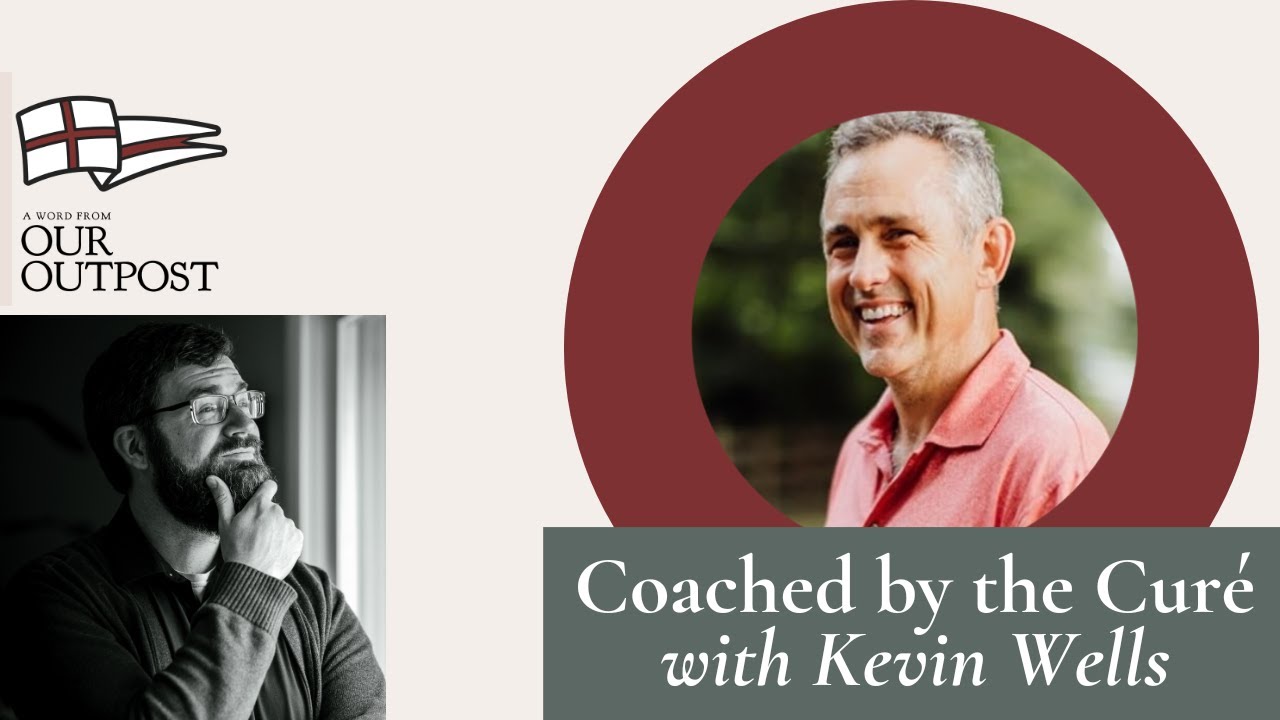
Author Kevin Wells talks with Joseph about his book Coached by the Curé, which offers St. John Vianney’s wisdom to Catholic parents who long to see their children keep the faith. They cover humility, sacrifice, mystical prayer and why we can’t presume salvation.
Episode 228 · 63 min · With Joseph Gruber and Kevin Wells
Coached by the Curé with Kevin Wells
Take the Our Outpost Quiz
A free four-minute self-assessment for Catholic couples and singles. Tell us who you are, answer a few questions, and get personalized results emailed to you, with at least one way we at Our Outpost can help you answer the call of matrimony.
Take the Quiz →Key takeaways on St. John Vianney for Catholic parents
- Parents are shepherds, too. The Curé of Ars asked, “What must I do to save souls?” Kevin hands that same question to moms and dads.
- Humility is contagious. As Fr. Vianney decreased, Ars grew kinder. When we see real humility, we want to become like it.
- Sacrifice is the hard pill. Of all the Curé’s habits, his asceticism is the hardest for comfortable families, but love that costs nothing teaches little.
- Start with prayer. Prayer is the easiest place to begin, and Kevin urges Catholics to rediscover contemplative prayer, pointing to David Torkington’s books.
- Don’t presume heaven. Kevin warns against the quiet assumption that everyone is saved. The Curé’s urgency came from taking souls seriously.
“When I see a model of humility… I find myself wanting to be like this priest or this person.”
Kevin Wells
Try this
Take one page from the Curé’s playbook this week.
Offer one hidden sacrifice for each of your children, and tell no one.
Set aside ten quiet minutes a day simply to be with the Lord.
Chapters
- 0:00 Welcome and opening prayer
- 0:26 Meet Kevin Wells
- 1:26 Coached by the Curé
- 2:15 A family of priests
- 4:15 Why write for parents?
- 7:15 St. Philip Neri
- 11:07 Model for every parish priest
- 13:26 What must I do to save souls?
- 20:08 Humility in Ars
- 25:00 The hardest pill: asceticism
- 29:54 The easiest place to start: prayer
- 33:00 Examples of prayer
- 34:48 Recovering mystical prayer
- 41:14 How the book changed Kevin’s family
- 48:48 The myth of assured salvation
- 51:31 Sin makes you stupid
- 53:14 Sharpened by the Lord
- 1:00:45 Closing prayer
Mentioned in this episode
- Kevin Wells, Coached by the Curé
- Kevin Wells, The Hermit
- Fr. Francis Trochu, The Curé d’Ars
- David Torkington’s books on contemplative prayer
As an Amazon Associate, Our Outpost earns from qualifying purchases.
Full transcript
Welcome and opening prayer
0:00 Welcome to A Word from Our Outpost, with Joseph and Crystal Gruber — a podcast for Catholic disciples who are wrestling to be missionary-minded in their normal and everyday lives. In the name of the Father, and of the Son, and of the Holy Spirit. Amen. Direct, O Lord, our actions by Thy holy inspiration, and carry them on by Thy gracious assistance, that every word and work of ours may begin in Thee, and by Thee be happily ended.
Amen. In the name of the Father, and of the Son, and of the Holy Spirit. Amen. Welcome to A Word from Our Outpost. I am Joseph Gruber, host of this podcast, and
Meet Kevin Wells
0:26 joining me today is author Kevin Wells. Kevin, would you introduce yourself? I would. Thank you, Joseph, for having me in. So just briefly, to your viewer, I raised a large Catholic family, loved the Catholic faith. I always liked to write, but I also liked to play sports, and I was able to marry the two and became a Major League Baseball writer, and did that for a while and really loved it.
But then I got into Catholic writing. In 2009, I’ve written five Catholic books. I do a good amount of writing for different periodicals and some speaking, and I guess my latest book on Coached by the Curé was released last week by Scepter Publishers, and I think, Joseph, we’re going to get into a little bit of that today.
Yeah, yeah, yeah.
Coached by the Curé
1:26 So I got a copy of the book on PDF, and I’ve been reading through it and enjoying it quite a bit, and so let’s talk a little bit about your background before we dive into the content of the book. There are some really fascinating things you bring up in the book. I want to get to them, but I know that you come from a family that has priests in it, and you are tapping into the voice of St.
John Vianney in this book, speaking on behalf of him in his voice. So tell me a little bit about your growing up, a little bit about your background, a little bit about how you have a brother who’s a priest, how he feels about you writing in the voice of a priest, those kinds of things.
Yeah, he’s like, Kevin, stop being so arrogant and talking about John Vianney. That sounds like a priest brother to me. Yeah, it’s a…
A family of priests
2:15 So I really do have a profound love for the ministerial priesthood, and I know actually from where it starts, it’s from Monsignor Thomas Wells. He’s my dad’s brother. I grew up in his shadow. In the 1970s, I used to ride my little bike to his rectory, and he was really a giant in the archdiocese of Washington.
He really led many, many men into the priesthood. He just… He kind of had the unfair gift of being sort of coming out of the birth canal with joy, exuberance, and when you combine that with love for the Eucharist, he had a devotion to the Eucharist, and also to Mary. When you put those three things together, joy for people, love for people, and the Eucharist to Mary, you become explosive, and his priesthood was explosive, and that’s…
I got to see him at a very early age, how much he loved the priesthood, and how much people loved his priesthood, and I think he saved quite a few souls, and I spent a lot of time with him, a good 20, 30 years traveling the world with him, Ireland, a couple trips, driving across the country to Montana, ski trips to Canada, all over, and I said, this priesthood thing, it’s a pretty good gig.
He gets to deal with souls and help souls, and then… And I established through him a lot of priest friends. I’m blessed to say quite a few friends were priests, and my brother, as you mentioned, Joseph, Father David Wells, has been a priest in the archdiocese of Washington for about 15 years, and I’ve always understood, I guess, through my uncle was a little kid that the priest really carried a lot of weight in persona Christi.
If he took his priesthood seriously, that he could help lead souls to heaven, and so… And I need, as a sinner, I need to be around good and holy people, and so I’ve surrounded myself with some good priests, I’ve been fortunate, and so yeah, so I think that’s why a lot of the books I’ve written, a lot of the articles, a lot of them center on holy priests.
Yeah. It makes sense.
Why write for parents?
4:15 Now, you’ve written a book for priests before tapping into the wisdom of St. John Vianney some years ago, but this book that just came out last week, this book is not directed to priests. This is actually a different audience in mind. It is. In candor, I wrote a book, as you mentioned, I was just arrogant enough to sort of enter into the mind of John Vianney 160 years after his death, and sort of speak with his voice, and the book is written by him, per se, and what I do is I pull him out of the grave, and he looks at 2025, and he sees a dystopian novel of things that have gone haywire, and rather than the patron saint of parish priests addressing bishops and priests in clergy, he says, no, I’m not going to do that.
Matter of fact, I’m going to speak specifically to moms and dads, and remind them that they are priests in the home, and in a very, I would say, interesting conversation in chapter one, you’re led to a very candid, very frank conversation in heaven, where God stands by noiselessly as John Vianney’s muse, Philomena, the little martyr Philomena, and about ten of the priest saints, St.
Peter, Kolbe, Bosco, Damien the Leper, and others begin to articulate some of the, I would say, negligence in the church over the past 50, 60 years, and they explained to John Vianney, we’re losing tens of millions of Catholics because of some of these negligence over the past 60 years, and so don’t worry about priests anymore, because in a sense, John, you’d be canceled anyway, because you’d be preaching about morality, principally on moral topics, and you wouldn’t last in 2025, so we’d like you to write a letter to moms and dads, and sort of give them that sacred blueprint of what they can do to become priests in their homes, to really lead their children through this moral wintertime of saturation and technology, cell phones, just entertainment.
Educators with Marxist ideologies, it’s like they’re growing up in a jungle, but you need to remind mom and dad that they’re custodians of their kids’ souls. They can’t rely on the local bishop, they can’t rely on the pastor down the street, even if the pastor is a good and holy priest. It’s their responsibility, so that’s what John Vianney does.
He sets down to write to moms and dads in 2025, not only to say, hey, here’s how to keep them in the church, but here’s how to go after the ones that are sort of lost to the world.
St. Philip Neri
7:15 I would be remiss if I didn’t point out that one of your priests in chapter one is St. Philip Neri, who is near and dear to my heart. Our firstborn is named Philip, one of my brothers is an oratorian priest, so he’s just a really incredible fellow. I would love to see a book written in his voice to the modern man.
You will. I will. In four months, one of my good friends has written a book called Coached by Philip Neri. No way. But the forward. No way. Because I’m also a big fan of Philip Neri, so your wish is my command, Joseph. You have a good book coming out this summer on Philip Neri.
Incredible. Also put out through Scepter or? Same series, same publisher, Coached by Philip Neri. Very cool. Well, I’ll look forward to that, and maybe we’ll have that author on as well. Nothing against St. John Vianney. I’m falling more in love with him as I read the book, but maybe it would be good for you to give our listener a reason to become a reader and a reason to become a lover of St.
John Vianney. Well, there’s countless reasons, but I’ll try and crystallize here. John Vianney was not gifted with intellect. He was considered really stupid. He failed at a seminary three times, was really kind of regarded as sort of a Forrest Gump-like figure in the priesthood. He kind of strange-looking, five-foot-one, kind of considered dim-witted, but seminarians said there’s something about the light in his eyes.
There’s something about his love for Jesus that seems higher than anything that intellectually he needs really to know. He doesn’t have theological opulence, but he loves Jesus. So when he finally became ordained in 1818, he was shipped off to this little podunk Mayberry town called Ars, where it was spiritually dead, especially after the French Revolution, where thousands upon thousands of Catholics were killed by Robespierre.
And when he arrived on that first day, so the bishop sent him out there because he’s like, what harm can the Forrest Gump priests do? He just sent him out to the parish where he can do the least damage. He’s of no consequence. And within 20 years, they had built a new train line to Lyon, just so people could pilgrimage down to see this obscure priest named Father John Vianney, who not only had saved all of Ars, which was spiritually dead, but began to resurrect all of France that really millions had left the faith because of Robespierre and Napoleon and the revolution and the guillotine.
This little John Vianney, this one single man through his priesthood and what he did for the souls that he loved really changed all of France. I mean, he did it through, obviously, his veneration, his love for Mary, and what he would say, his little miracle worker, Saint Philomena. But yeah, that’s why in 1929 Pope Pius XI said this John Vianney, he is the patron saint of all parish priests.
And actually in May, May 31st of next month will be the 100 year anniversary of his canonization. And so he really is the model. Benedict said it, John Paul II said it, John XXIII said it. They said that John Vianney is the model for all parish priests worldwide. Yeah,
Model for every parish priest
11:07 and I forget the name of the priest who wrote your foreword, but he mentioned he went to Saint John Vianney Seminary and they never talked about Saint John Vianney. Now you’re diagnosing the problem, Joseph. That’s the problem. And that’s why I keep writing books and articles. Yeah, it was startling. The priest’s name is Father Jonathan Meyer.
He’s become a very close friend of mine. He’s the pastor of seven parishes in Indiana. He is a John Vianney. He said John Vianney was my seminary. His homilies, that was my catechesis. He is my priest to it. And he said, I found it startling and heartbreaking that I went to a seminary called Saint John Vianney and no one spoke about him.
You had to read him in private and he found it heartbreaking because he was a guy who loved Vianney and he understood the magnitude of what John Vianney did. But because what John Vianney did was an ascetical priesthood, he took things on. He mortified his senses and emotions and body. He was in the confessional every day of his life between 12 and 14 hours.
He taught catechism every single day. He read the lives of the saints every night. He poured himself out. I think, sadly, I’ll be candid here. I think a lot of that type of priestly libation, that pouring of oneself out as a priest, it’s been lost. This Holocaust that John Vianney made of himself for souls that changed all of France.
Well, I think in modern days, a lot of the church sees that as something outdated or unhealthy or psychologically taxing on the modern priest. They’ve locked his story behind rectory doors. Hey, don’t open that door to Vianney because we got to hide that monster. That’s too much. That’s another reason why I took him out of his tomb.
I unlocked that rectory door. I broke the code and got him out. That’s why I held him up for 2025. But again, I haven’t showed him to priests because I think many priests have rejected Vianney. So, I show him to moms and dads. Yeah,
What must I do to save souls?
13:26 and I think there’s a question that gets echoed several times in the beginning of the book that St. John Vianney is asking, what must I do to save souls? Right now, how dangerous that question is to our comfort, because God might ask anything in response to that question. What must I do to save souls?
And St. Philomena, Mary, our blessed Lord himself, chart out what St. John Vianney is supposed to do in order to save souls. And I think oftentimes we’re afraid to ask that same question. Maybe because we think we’ll have to do whatever St. John Vianney did. But regardless, it’s the lack of that question that I feel is so apparent.
I’ve been running into a few parochial parish politics problems of late. And it came to me like, these are all coming about because nobody’s asking the question, what must I do to save souls? If that question is asked, all of that other stuff gets swept away. Yeah, you’re on the hook. And it’s really a prayer when we pray to God and ask that question, whether Lord, help me to suffer from my son who’s left the church, or what must I do to save souls?
Lord, tell me. Lord, all my family has left the Catholic faith. What do you want me to do? Well, God answers those questions 100% of the time in some form or fashion, and you get your answer. And I think the reason the questions like that aren’t routinely asked is because it demands a cost.
There has to be a subtraction in annihilation of the self-will where there has to be a death to self. Because once God answers your prayer, well, then you’re on the clock. And then it’s go time. And John Vianney, the first day he arrived in Ars, he knelt down and as his biographer, Trochu.
So there’s many biographies written on John Vianney’s life, but they say routinely, Trochu, Father Trochu wrote the best. And I believe he did as well. John Vianney knelt down when he realized the magnitude of the spiritual desolation. And he said, Lord, I will give up the rest of my life a hundred years of suffering.
I will take anything on if you will just give me the souls of Ars. He wasn’t thinking of France. He was just thinking of the burden of his identity as the shepherd of Ars. And he said, Lord, please give me the souls. I will die to whatever I need to. And then again, 20 years later, this spiritually bereft town became a town of willing martyrs.
They all became changed because of what this priest began to do. Yeah. Can we talk a little bit about the change that was affected in that town? That’s something that you do in chapter two, I think, where you paint a picture of the town transformed. And I found it very moving. I found it very helpful for considering my own work on mission as a lay in person, just like what is it we’re aiming for?
Yeah, well, Ars when he came into town on that winter day in 1818 was a town of decadence. There’s three bars in town, taverns. There was a very popular cabaret. At the heart of things, there’s nothing wrong with having a beer and hanging out with some friends and seeing a good show. But he knew that there was a lot of post bar, post cabaret relations, sexual relations going on in the town because they had lost any kind of sense of their soul.
Yeah, I’m saying I’m having premarital sex, but what of it? It’s okay. Again, this was a countryside that had been annihilated by Robespierre, where priests at this time, either were guillotined because they would not leave the faith, because they were true priests, or there are other priests that signed what was called a letter to Robespierre, where they turned over their priesthood to the government, where they essentially signed a contract saying, I will no longer preach on the Virgin Mary, I will preach on Mother France, I will no longer preach on the need for prayer, I will preach on the need for service.
And so there was a bunch of Judas priests that spread out throughout the landscape of France, and that’s why Ars was dead. And that’s why they committed sin freely, with no consequence, they didn’t really think about it. So John Vianney understood that a death to himself needed to come. And so really, it was a town of decadence.
And that’s when he continually went to God during that time and really read the lives of the saints, because he knew that Ars didn’t just need a holy priest, Ars needed a saint. And he began to study the lives of the saints to see how they took on villages and towns and cities of decadence down the millennia.
And he just tried to do, he sort of followed the sacred blueprint, and he just tried to do what they did. And he was very successful. Yeah, could you speak into what the town looked like after his ministry, after his time as a priest in Ars? Because I’m thinking of a particular paragraph where you paint this picture in chapter two, where you describe how the farmers relate and how the husbands and wives relate.
Well, so without knowing exactly that paragraph, what I think you’re what I think you might be saying is, John Vianney didn’t have any difficulties going into the farmhouses and into the fields of those who had stopped attending mass. And he would love them and work the potato farms with them and help out with the cattle and the husbandry and all that.
But at the end of the day, when they invited him into their homes, John Vianney would speak about their souls and the fact that they’re probably going to lose their souls to hell. And he began to win them back, because when he did speak about them losing their souls, he was often weeping, because he was sad that they were losing their souls.
So they might have been upset that he was saying, you’re probably going to go to hell. You might have been angry, but when they saw that they were accompanied by tears of sadness, they began to love him because they knew that he was a shepherd of their soul. Now, I don’t know, Joseph, this is what you’re referring to.
Please refer to.
Humility in Ars
20:08 Oh, yeah, I can read the paragraph, Kevin, if you don’t mind my reading your own words back to you. Please do. But the paragraph’s on page 52. [Joseph reads a passage from page 52 describing how, as Fr. Vianney decreased, the town grew in quiet kindness and husbands began walking to Mass hand in hand with their wives.]
That one. Yeah, man, that was, that’s what happens. You know, that’s what happens. We’re, I think, I’ll speak for myself. When I, when I see a model of humility, I think that chapter was on humility. When I see a model of humility walking the streets in a priest, or whoever it might be, maybe just a neighbor, there’s a conversion that maybe it’s in piecemeal fashion, but it, but in, in this slow motion fashion, I find myself wanting to be like this priest or this person.
And that’s what happened with these farmers. They, they saw a humble man, and they knew that they, they had a lot of pride, and they needed to die to this pride, and they began to, as, as you just read, Joseph, without belaboring the point, they began to change. And that’s, that’s the, that’s the byproduct of, of a saint.
Saints, saints create saints, and that’s the way it is. Always has been. And humility inspires humility, right? Like I, I want to become more humble reading about his humility, right? Yeah, that’s, that’s, that’s essentially, you know, Joseph, that’s the book. The book is, like, for instance, again, the book is written to, written to moms and dads in 2025.
And oftentimes a dad or a mom will be angry at a son or daughter who’s left the church or in college, they’re not going to mass anymore. Maybe they’re young professionals and, and they’re just angry. And, and, but a lot of that is pride. Like, oh, how dare my son leave the church.
Doesn’t he understand the way I raised him? 12 years of Catholic education. Look at him now. He’s in the world. And well, get over yourself. You know, you, where’s your humility? Where’s your love to your son or daughter? Who, who noiselessly screams for you to love them, even though they’ve left the faith.
You know, will you become humble? Like, sort of like the, the, obviously the father of the prodigal son and wait on the porch as your son or daughter is with the pigs or live in a decadent lifestyle. Well, surrender your son or daughter to God and you fast and you pray and you hope.
And when you see them and whether they’re converted or not, you love them regardless. And that demands humility. So that’s sort of the, the blueprint of the book. It’s, it’s trying to point out the characteristics that John Vianney showed to spiritually resurrect ours. It’s the same thing that moms and dads, myself too, need to do with my own children to kind of stay in the game with our kids that may have left the faith or were struggling to raise in the faith.
Right. Yeah. The, the better example we offer them, the better chance they have to imitate it. That’s it. So you have, well, how many chapters? There’s a chapter on humility, on prayer, on Mary and her queenship. Magnanimity was one of them. I’m trying to think of what the other ones were. So we, we have, we have, obviously, well, not obvious.
I don’t know how many of your viewers would know, but he lived a very ascetical life. He mortified his priesthood. That’s another, I think, one of the most important chapters is that we need to die to ourselves as moms and dads and sacrifice. Obviously, prayer and adoration. Another one is, is the last chapter is how to achieve sanctity.
Like, how do we become saints? Because there’s no really Palestinian caves that have the hidden scrolls of how to be a saint. And it’s sort of the last chapter is a penultimate overview of, of what moms and dads can do today to become holy, to become saints, to save their children’s, to sort of lead their children back.
And so that’s a big part too, is just a blow by blow of what a mom and dad would maybe want to consider as, as they’re struggling to just keep their children close to Jesus Christ and close to Mary’s immaculate heart. Yeah.
The hardest pill: asceticism
25:00 Of all the chapters, which one do you think is the hardest pill to swallow? Which one do you think, man, oh man, when I look out into the world, this is the ones that mom, this is the one that moms and dads would not want to read. I think that’s an easy one.
And it’s the hardest one for all of us. It’s, it’s taking on the ascetical life. Yeah. John Vianney may have, you know, many people would agree, lived the most ascetical priesthood in the history of parish priests. His entire life was a mortification. He lived a mortify, he lived the crucified priesthood in, in multitudinous ways, but just, just to name just a few.
He slept on the bare, he slept on the floor most nights of the year, slept in attics, only ate a few times of the week, woke up usually between two and three every morning to start his day, worked 18 hour days every day of his life, stayed in the confessional in the summertime when it was in the nineties in France, 90 degrees, no, no fans and no air conditioning back then where he heard 12 to 14 hours of confessions.
It’s pretty hot in there. Winter time, very cold in France. Same thing, 12 hours in 21 degrees, not very comfortable in there. So he, he died to himself so that souls could live. So today, you know, I, I often think that the great, one of the greatest poverty is, and it’s not often talked about in the West is the poverty of the warm blanket.
So what does that mean? So when I wake up in the morning and the blanket feels just right and the alarm goes off, well, I might hit that snooze button seven times because I just feel too comfortable. And when I finally get out of bed and that coffee better be perfect. If it’s not, I’m going to be pretty hot.
And, and I want those slippers to be good too. And so as we in the West live this poverty of comfort, we lose sight of God. We, we, we, I don’t really want to pray because I’d rather watch a YouTube video and I’d rather scroll, just scroll and scroll and scroll and feed this, this, this beast that needs to be dopamine fed.
And that’s what happens when we’re comfortable is God disappears, God vanishes. And I, and, and sadly, and Joseph, I know you that I know this in you and I, I’m not, I don’t want to speak for you, but I imagine you see it just with focus that, that a lot of the youth culture has, has become hijacked by algorithms and technology and they’re drowning in, in this little demon in their pocket.
That’s called a cell phone. And a lot of that is because they have, I don’t judge anyone, but it’s the, it’s the poverty of the warm blanket. They just want to be fed by something comfortable. And I, and I, I’ve come to believe that maybe that’s what’s really hurting our church the most right now.
Bishops, clergy, lady, myself, is I just want to be comfortable. And John Vianney says, no, Jesus Christ was a starved man on the cross who poured himself out violently. There was no comfort in that. There was no consolations. And if you were to love as, if I am to love as a father and as a husband, as Christ did, then I’m, I’m going to have to love by pouring myself out and taking on things that I don’t want to take on.
I’ve got a sacrifice. I’ve got to sort of annihilate myself, will, you know, a couple times a day, five, six, seven times a day to do the harder thing. And the thing I don’t want to do because it’s love. And, and that’s what John Vianney did. And, and as you mentioned, Joseph, I’m glad you read that paragraph.
That’s what the farmer saw. They saw, they saw a man who was dying to himself and these farmers knew that they needed to die to themselves, their pride, their anger, their reluctance to go to mass, all those things, you know, you, you mentioned, they began to hold their wives’ hands as they were.
Well, they, they understood, yeah, how dare I not show my love for my wife with a little bit of PDA, a little public display of affection. So they said, yeah, I have to die to my pride and start giving my wife the love she deserves. Well, that’s one of these choices that we all have to make is we, we, we love by doing things we, we simply don’t want to do.
Well, that’s how Jesus loved. We remember the garden. Father, if you can just take this child and make it pass, but no, but father, your will, that’s the way to love. The best way to love that I know of the centerpiece of my identity should be Jesus Christ spread out on a cross who poured himself out in love.
And that wasn’t easy. And it can’t be easy for me either.
The easiest place to start: prayer
29:54 So I’m going to ask you the opposite question now, Kevin, which of those elements from St. John Vianney, do you think is the easiest pill for her moms and dads to swallow today? That’s a great question. I would, I would think the best place to start, the easiest place to start is with prayer.
So John Vianney understood early on that he couldn’t do anything well as a priest unless he began to present himself before Jesus and the monstrance. He was very devoted to Jesus exposed in the monstrance. So he began to absorb or receive Christ. So he knew he needed to be divinized or infused with the wisdom of Christ to understand how to spiritually lead this decadent town of Ars back to the faith.
So he prayed and he prayed and he prayed and he begged. But he did not, it was almost like that that front pew of his little parish Saint Sixtus in Ars, this little runt of a French parish, that little front pew in front of the monstrance became like a hermit cell. He just didn’t leave it.
He just prayed and prayed and prayed and he had a supernatural faith that God would respond in his prayer and God did. So for today’s mom and dad or maybe anyone else who would be watching this podcast, just start with what John Vianney did. Just start going to God in prayer and just speaking to him like a little child.
John Vianney spoke to God like a little child. Remember, he wasn’t gifted with theological opulence. So he had to speak to the father in the words of an eight-year-old boy. Jesus, I need your help. I don’t know how to take this flock and bring them back to you. Please tell me what to do.
I’m kind of lost here. And when you do hours and hours and hours of that in front of Jesus in the monstrance, well, Jesus is going to respond and he’s going to tell you what to do. But again, it’s going to be hard. But John Vianney said, Lord, thanks for answering. Let’s go.
Oh, I’m going to go now. And he did. And he didn’t waste any time either. He dove in. And so, yeah, I would think that would be it. Just begin in prayer and maybe you’ve never really committed to a holy hour or maybe your prayer life is you feel like your prayer life is lacking.
Well, that’s easy. Just say tomorrow I’m going to wake up and I’m going to wake up 30 minutes earlier and I’m going to light a candle and I’m going to spend the first 15 minutes of the day in prayer. Or maybe I’m going to stop by my parish once this week and spend 15 minutes in a holy hour.
And you know the way it works after a year, that 15 minutes in prayer in the morning maybe gets extended to an hour. And maybe that 15 minutes of holy hour, your sign up for an hour a week where you’re going to holy hour at two in the morning because you because Christ is infusing you with his love.
So, yeah, I think just starting with a little bit of prayer is the way to go.
Examples of prayer
33:00 Yeah, I think in that chapter on prayer, you offer some really solid examples that I don’t… I’ve seen only maybe one other place before, one in particular. One is that he had a cell in his heart that he would return to where he sat on a bench and Christ sat on the bench and there was a kettle for tea always at the ready and then he would be able to talk to Christ face to face there.
I think that imaginative prayer, I had a spiritual director once, this was how he prayed and most people don’t even think about the fact. Christ is here right now. He is present right now. That is the glory of worshiping the omnipresent God is that Jesus is here right now waiting for us to talk to him.
And the fact that John Vianney did that, there are other elements of prayer that you brought out as well, right? Like the fact that he would return to these moments of prayer in his past where he found consolation, where he could remember saying the rosary with his parents, where he would think on his brother praying in the battlefield, these moments of turning to other moments of prayer as moments of inspiration.
And then also the delighting in the hidden years of Christ, the time that he spent with Joseph and Mary, the time that he spent as a child, the time that he spent working and playing. And the fact that the book opens those possibilities up for people, because I just don’t see people talking about those ways of praying very often, Kevin.
Yeah, Joseph, I’m on my little microscopic soapbox right now. Please. Yep, that’s what you’re on. All right,
Recovering mystical prayer
34:48 I will say one of the greatest abdications of the Catholic Church over the past 1,500 years is the rejection of mystical prayer or of contemplative prayer. So the way that Mary prayed and Joseph prayed back in the day was sort of the Jewish rabbinic way of praying. Seven times a day, they would chant the psalms and they would fall into the psalms.
They prayed contemplatively. All the post Pentecostal disciples and apostles, they had the advantage because some of them saw Jesus and then they heard about the stories of Jesus. So their prayer was being absorbed in thinking, contemplating the life of Jesus, actually seeing it, nouns and verbs. And this was passed forward for generations, for a millennia.
And then what happened is after the Renaissance, all of a sudden, I believe what happened is when Stoicism came, there was a shift. And Catholic intellectual leaders and bishops and popes began to say, we need to study Jesus more. We need to, we really need to understand Jesus more. And all of a sudden, rather than contemplating Jesus, seeing Jesus so we could become like Jesus and have Jesus infuse himself into us, we began to make Jesus sort of a scientific figure.
And we began to detach from Jesus because we were always studying and studying and studying. And at the end of the day, you can spend your whole life and study of Jesus, but if you’re not absorbing Jesus into your soul, then that’s great. Great books, great treatise, great philosophical discourse. But where’s Jesus?
Yeah, I know all about him, but where is he in your life? So, yeah, I think the rejection of mystical prayer, which the church had done for 1500 years and has not done for the past 500, it’s a great scandal on the church. And with the lack of meditation, a consideration of the supernatural, the miracles, seeing Jesus, as you mentioned, Joseph, seeing Jesus as John Vianney did sort of in a cell in his soul and spending time with him, just sitting with him.
You don’t need to speak to Jesus because you’re there with him. He’s already in your, as the advocate, he’s already in your soul to begin with. So, you just spend time in silence. You absorb him. He comes in, he dwells within you, and then you can love the world, but you can’t love the world well if you study Jesus because Jesus hasn’t come in.
Now, you might be able to love the world well. I don’t cast judgment on anyone, but when you actually receive Jesus in that mystical way, contemplative way, then you be, I think Jesus will say, okay, I’m in you now. Now’s the great commission. Now go out to your children, to your neighbor, to wherever you need to go, but it’s me loving.
It’s me loving others through you. So yeah, that contemplative notion of what John Vianney did, boy, I’d love to bring that back to the fore in the Catholic church, but I don’t know if that’s going to be coming back anytime soon. I mean, you see hints of it, right? Like there’s Ignatian, contemplation, like an Ignatian meditation, like these imaginative enterings into Scripture.
But I feel like the Jesuits, you know, they have their ups and downs in history. And yeah, but for them, I don’t like to get too controversial on this podcast. Sorry about that. I don’t like to get too controversial, but to know that Saint Ignatius of Loyola, I think, did want people to have this enriching, intimate connection with our Lord and to not see very many lay people even know that that’s a possibility is very sad.
Yeah. So it’s funny you say that when I came to understand what’s the right word, the transcendence of mystical prayer, of contemplative prayer, I actually did a nine month Ignatian retreat, which is the spiritual exercises for nine months. I won’t go into what it entails, but one thing it entails is every day you go into an hour of prayer, of contemplative prayer.
So you read, it’s a directed retreat for nine months and you’ll read. So your director, in my case, a very holy Jesuit would, I’d meet him every Saturday. I drive out to Georgetown University and he’d give me a scripture passage sort of based on the week I just lived. And then I have to go back home and every day I would meditate on that message, on that scripture or whatever it was, or maybe it was something from that Ignatius of Loyola said.
And I’d have to spend that hour in silence. And that’s when I became the value contemplative prayer and what it was able to change, sort of scalpel out of my own life, my deficiencies, my sinfulness, the things that really had to go. And because why? Because Jesus was speaking to me in that silence.
It’s not always easy, but on the good days, you do feel that fusion of Jesus in you and you’re led to do things and to eliminate things in your life and to change things. So yeah, I don’t know why the church has abandoned it. You’re right. There’s some priests that believe in it.
There’s a lot of folks out there that teach it, Father Timothy Gallagher, et cetera. But for the most part, it’s been kicked to the curb and it’s a tragedy. Matter of fact, one of the, I think, the foremost mystical theologian today in the world today, his name is David Torkington. He lives in England and he’s written many books.
I would encourage your viewer, David Torkington. He’s turned over his last 60 years of his life writing these books about mystical prayer and they’re fascinating. And I would encourage all of your readers to take a look, David Torkington, and you’ll come to know the efficacy of mystical prayer. Awesome.
How the book changed Kevin’s family
41:14 To switch gears a little bit, in the writing of this book, how has that impacted your family? Ah, that’s a good question. See, they’re kind of used to this knucklehead. I’m always writing Catholic books. I guess the way, in a practical way, the way it’s impacted them is they’re tired of me talking about Javi.
Javi. But I think with my kids, so I only have one at the, really one at the house anymore. I try and pour myself out in that sacrificial dimension, that John Vianney. So whenever you research the life of somebody like John Vianney, it’s the kick in the teeth. It’s like you’re not, you’re just, you think you’re a good Catholic dad and a good Catholic husband, but you’re not even on the JV team.
You don’t even make freshman team. You’re barely on the bench. So you’re pulled to a different level of intentionality. So I guess I’ve come to see the sacrificial dimension of myself as a father and a husband. Nobody wants to talk about how they live their life, but I think it’s been changed subtly.
Hopefully my daughters and son and wife would say the same, but it’s really, it comes down to, I really think it’s this simple. It’s a choice. So we’ll go back to Ignatius of Loyola. He used to talk about, there’s two standards. So you’re either, so a standard back in the day was this big, long, vertical flag.
And one standard is the standard of Jesus Christ. I stand beneath the banner of Jesus Christ and the other is the standard of Satan. And there’s no in between, pick a side. And that’s what Ignatius of Loyola said, have a plan of life, pick a side and don’t deviate. And that’s what John Vianney says, make a choice, will you die to yourself in love or will you sort of fall into that poverty of comfort?
Make a choice. And we all have a conscience, this Aboriginal vicar of Christ that John Newman talked about, and we all know when we’re choosing comfort and like I know when I choose comfort, I know it immediately. I might reject it or rationalize it or give myself, well, I worked hard today, so I’m gonna scroll for 10 minutes of my cell phone, but I know deep down, I’m choosing comfort.
So I really, I think that’s it. To answer you, Joseph, I think more and more because of John Vianney is the idea, just make a choice. Either go to the side of, I hate to say it this way, but I will, the side of Satan or the side of Jesus. Jesus sacrificed and bled out, Satan wants you comfortable.
Yeah, I mean, we may hate to say it, but those are the choices, right? Like there aren’t three ends that we might end up at. There’s only two, and so it does need to be said. It is uncomfortable and it is harsh sounding, but much more harsh would be to tell people, no, no, there are infinite number of ends that you can have.
You can have any way you like. You can have, you can follow anybody and be fine. And that’s just not, that’s not going to actually serve them. But the sadness, Joseph, is that’s why 100% John Vianney would be canceled today, 100%. If he actually did come back from the grave and actually was flesh and bones and soul and began to preach today, he would be a canceled priest, 100%.
And that’s the great tragedy of the modern Catholic Church is John Vianney preached to souls. He preached, so he preached principally on morality and, and eternal consequences. And, and it was tough, it was tough on the ears of these folks that were living in sin. But again, when they saw that his proclamations were accompanied by tears, because he loved them, they changed.
And the great sadness today is many clergy have genuflected to the world. Now, I know we’re going to try and keep this a PG-13 podcast. Yeah, but it’s a very, it’s a very sad reengineering of the ministerial priesthood where many priests seem to want to have re-engineered the prophetic voice. The definition of priesthood since Melchizedek has been sacrifice.
A priest is to offer sacrifice and to offer sacrifice. You need to do hard things. You need to die. Abraham, the father and the faith was willing to kill his son. That was, that’s a sacrifice there. And so again, we’ll go back to the poverty of that warm blanket. I, that doesn’t conform with John Vianney.
He never lived a minute comfortable in his life and he changed all of France. It’s like, for me, it’s a matter of mathematics. It’s just, okay, this guy changed an entire country by living uncomfortably. Jesus Christ redeemed all of humanity by living uncomfortably. Not only was he nailed to the cross, but he lived as the poor man of Nazareth.
He had nowhere to lay his head. He lived in poverty and he redeemed the whole world. So the equation is if I’m going to be like Jesus as a dad or a priest or a bishop, it demands me dying to self and living uncomfortably because I want to lead souls to heaven. And to do that, we need to take on the demands that Christ has asked us to take on as his follower.
And we all know what he said to the rich young man that walked away sad, unless you pick up your cross daily and follow me, it’s going to be hard to enter the kingdom of God. So why wouldn’t a priest want to proclaim that to shacking up couples, to those who are contraceptive on and on and on to those third rail topics that many priests and bishops ignore or neglect or conveniently don’t preach on?
Why would they do that? It would have made no sense to John Vianney. And that’s why in 2025, he would be a canceled priest. Yeah. I mean, we’re dealing with generations of people making absurd choices about their bodies, about their families, about their whole understanding of sexuality and their whole understanding of their faith and the ripple effects.
If a generation were called to repentance, how great that repentance could be, how beautiful it could be. I’ve seen signs of particular couples who made choices they now regret, now they’re retired, and now they’re pouring their lives out. They’re not capable of having kids or any more kids, and they pour out their lives as a sacrifice in their community now.
And it’s their way of making reparation for these things. But if everyone were called to a kind of repentance for the sins, as you said, for contraception, for abortion, for pornography, for all of these different things, if we actually lived out a life of repentance and made reparations, how beautiful the world could be made.
So Joseph, you said it beautifully and perfectly.
The myth of assured salvation
48:48 The issue, if we can sort of go rubber meets the road, is the unspoken new mantra, even in the Catholic churches, the two words that are of hell, and that is assured salvation. So even Catholic parents today, many millions, maybe whose children have left the faith. Well, they’re good people. They don’t go to Mass anymore, but they’re nice, and they visit, and they make phone calls, and you know, every now and then they volunteer for things, so they’re going to go to heaven.
John Vianney wouldn’t have accepted that. It’s the scandal of, so there are countless millions of parents who mourn and lament and sacrifice and fast for their children who have left the church because they’re concerned for their souls, and they love their children, and they want them, as Jesus said, to live in the fullness of abundance, the abundance of joy, and they know that until they come back into the embrace of Holy Mother Church, that they’re never really going to have it, and they mourn, but there are also countless other millions of other parents who aren’t even trying because little Annie and little Jason, now who are young adults, they’re going to go to heaven anyway because they’re nice.
The scandal of the church is many people don’t know what you just proposed, Joseph, and that is the reparative acts for past requests. And like the absurdity of saying, well, they’re going to go to heaven because they’re a good person. It blows the mind because heaven is a relationship with God. And if I don’t want a relationship with God now, why would I want one later?
If I don’t take time to be with him now, if I don’t want to receive anything from him now, why would I want to receive anything from him later? The absurdity of that kind of stance, it just boggles my mind, Kevin, right? Like it betrays so little thought about what the words even mean.
Like we’re being inundated with these images of clouds and harps and robes instead of the face of Christ who is looking at us with love, waiting for us to look back to him. And because we don’t have that, we get away with people saying, well, they’re going to go to heaven because heaven is the place for good people.
It’s like, no, heaven is the place for those who love Christ, the people who long to see his face. That’s what heaven is. Yeah, just like the lack of meaning behind what people are saying when they’re saying that. Yeah, it doesn’t make sense. There’s no logic to it.
Sin makes you stupid
51:31 So one of my priest friends, so I wrote a book, came out in the fall called The Hermit, and it’s about Father Martin Flume. He’s actually now a consecrated hermit. You won’t ever see him again on this side of eternity. Truly the holiest and wisest priest I know, and also he lives the most hardcore, ascetical life.
Now his entire life is lived in mortifications, penances, and prayer. He lives in a cell in a forest on cloister ground. So as wise as he was, he would say, well, Kevin, sin makes you stupid. So when you’re just clouded in the world, an idea will come that sort of sticks like, well, my son is nice, and he volunteers sometimes.
So he does things that Jesus would have him do. So he’s going to go to heaven. Okay, that’s great. So he must be fed by the sacraments. Oh, no, he doesn’t go to mass anymore. But man, when I think about him sometimes, I think about, you know, what would Jesus do? And that’s what he does.
Well, what would Jesus do? Jesus would go to the Father. Oh, well, he does when he does something. So you can’t again, sin makes you stupid. So you’ll win the you’ll win the interior argument, because the conscience has been so dulled, it’s been so blurred by the world. And again, I don’t judge anyone, because if I judge anyone, I imperil my own soul.
But I’m just trying to think of it logically. And I actually what Father Flume told me, he said, Yeah, Kevin, you know, just sin makes you dumb. So, so sometimes I think you have to boil it down just to that. Well, I think that’s such a great reason to bring John Vianney into the into the whole narrative,
Sharpened by the Lord
53:14 because he wasn’t intellectual. But he was sharp, right? Like he was sharpened by his relationship with our Lord, by his ascetical life, by his humility, by his prayer, that made him sharp, right? Like, his intellect may have been dull, in terms of the natural abilities that he was given. But his ability to speak to the heart of the matter is the thing that blows people away.
Yes, but there’s something else something deeper than that. You’re right. You’re exactly right, Joseph. But but here’s something that so John Vianney, again, failed out of seminary three times, he’s one of the only homeschooled seminarians in the history of the Catholic Church. But when he became a priest, he knew that he couldn’t just say, Oh, I barely snuck in by the skin of my teeth.
I’m a priest now, he began to read voraciously, the church doctors, the lives of the saints, if you can see his bedroom and ours, it’s it’s still the same. There’s bookcases filled with compendiums on the church doctors, magisterial teachings. So he need he couldn’t just settle for it. So he read and read, because he had to make it.
It’s like, it’s like a basketball player who’s pretty good, but he can’t dribble with his left hand. Well, he’s not going to keep dribbling with his right. He says, Well, I need to overcome my weakness. And he starts dribbling all the time with his left, because he wants to become the best he can become.
And that’s who John Vianney was, he identified his shortfalls and the things that he really wasn’t graced with from God. And he said, I got to go to those places too. And I think I’ve been guilty of this. I’ll go to just my strengths, because it’s easier. Like, these are things that kind of come natural, and I like them.
Well, John Vianney did that, but he also went to the weaknesses, because he needed to be the full man, the full sacrifice, the slaughtered lamb poured out completely, not just 75, 80%, but everything. So he went at he tried to become the fullness of the man God wanted him to become. That’s beautiful, because like, it’s one thing to sacrifice one of the so-so sheep, but it’s so much better to sacrifice the yearling, who is unblemished, who is perfect in every way, shape and form like that.
That’s the sacrifice you actually want to be able to make the best. Like the Catholic Church, the whole tradition, all throughout salvation history is this idea that we actually give of our best to God. And for that example, again, he’s great for 2025. Yeah, when you go back to the Passover lamb, it had to be unblemished and spotless.
We know that. And again, I know this is PG-13 podcast, but I think we’ve seen in 2002 and 2018, that the spotless bride has been corrupted by sin. The veil was torn with the revelations of great depravity in the church by men, you know, Jesus, what Jesus established is a spotless bride. Peter carried it forward.
But you know, men were all sinners, we infected the spotless bride and but because the church now doesn’t seem to want to present itself as what Jesus established in 33 AD, we’re sort of limping around with this with this church that has been so stained by sin. Now we know it’s perfect. We know it’s flawless, it’s spotless, but it’s marred with sin at the very highest echelons of the church.
And until it’s purified by disinfecting light, then we’re going to continue to limp and our kids, our children are going to keep bleeding out of the church. The latest Pew Research poll three months ago, I think, said that for every 100 Catholics that come in the door, eight, eight hundred and sixty go out the back door.
And that’s a stunning thought. Matter of fact, I think the plus minus ratio of people that come in and leave the greatest denomination, the greatest faith in the world that’s losing more is the Catholic church, more than Protestants, more than Muslims is the Catholic church we’re losing. They’re bleeding out like the Israelites from Pharaoh.
And until this church becomes at least attempts to become the spotless bride, the flawless spotless bride that Christ established, well, until the church and me attempt to become like John Vianney and just try and eliminate all my sinfulness and die to myself for souls, then I don’t know how it’s going to come back to this place of purity and holiness without Jesus God sticking his finger into it.
Because you know, we’re a suffering bride right now. I mean, I have joy, I have hope, because we see so many manifestations of hope in the church, but we got to be a clean church. Yeah, I think that’s a beautiful thing. You begin your book with the McCarrick scandal on the one hand and then reading The Life of St.
John Vianney on the other hand and realizing like what you have before you is what you can do, right? Like to love your wife, to love your children, to love your neighbors. Like that actually is going to do the most in terms of what’s within your circle of influence. And for this book, say like actually it begins in the family, that is where we should be turning our attention.
That is something that is worth pouring ourselves out for. Well, that’s why I wrote the book. You just said I wrote it for the family. This book, John Vianney’s voice goes to mom and dad and the family, not to the church. I’ve written plenty of books for the church and for priests and yeah, just arrogant enough to do that.
But now I’m just arrogant enough to speak with John Vianney’s tongue. But I studied his life and I read his biographies and it’s not too difficult as an old journalist just to sort of report what he did through a story from his own life. But yeah, this book was written to travail, anxious and suffering moms and dads who are struggling to raise their children in the faith or who have lost their children to the world.
And all it is is Vianney saying, hey, mom and dad, I’m with you. I had the same problem in Ars, France. My town was dead too. I’m going to help you out and I’m going to show you what I did in Ars. And you can do the same thing in 2025 because as I was a shepherd, the characteristics of shepherding, they are immutable.
They’ll never change. So you can do the same thing that I did in your own home. And so I think it’s a very hopeful book. Hopefully moms and dads will, and anyone can read it. I mean, but I think for moms and dads, all it is is John Vianney saying, hey, let’s get on the railroad tracks.
Let’s start going northbound. Let’s lead those kids to heaven. And here’s how I did it in Ars. And maybe you can do it the same in 2025. Awesome. And there will be a link in the show notes where people can go and purchase it. I recommend it. I think it is well worth sitting down and reading.
I think it’s a great introduction to the life and thoughts of St. John Vianney. I think it’s really encouraging for mothers and fathers, for husbands and wives. And I think you have a really beautiful tone throughout. So yeah, I recommend it.
Closing prayer
1:00:45 And on that note, would you close us in prayer, Kevin? Oh, yes. Thank you, Joseph. In the name of the Father, and of the Son, and of the Holy Spirit. Amen. St. John Vianney, thank you for this past hour where you’ve allowed us to speak of your great and holy priesthood. I pray that your way of sacrifice, your way of love, your way of pouring yourself out, that God, through your intercession, might help moms and dads throughout the west, throughout the world, to come to the understanding of the Son who loved in the same exact way, the one who poured himself out to save all of humanity from its sin.
John Vianney, we ask you to intercede and ask Jesus to help moms and dads who are suffering right now from the loss of their children leaving the church, the moms and dads who are suffering just to keep their children in their own house, close to the sacred heart of Jesus. John Vianney, I ask Jesus to help all of these parents throughout the world, give them strength, give them hope, and give them the right understanding of what it is to lead their children to heaven.
Amen. Thanks for listening, and a special thanks to JohnMarc Skoch for the music. Check him out on Spotify.
Keep listening
Share this episode
Know a parent praying for a child who has drifted from the Church? Send them this conversation.