
We can’t add length to today, but we can add depth. Starting from an old funeral-home joke and a Doctor Who episode, Joseph Gruber uses the four phrases of the Confiteor (our thoughts, our words, what we have done and what we have failed to do) as a guide to living a deeper life of love of God and neighbor.
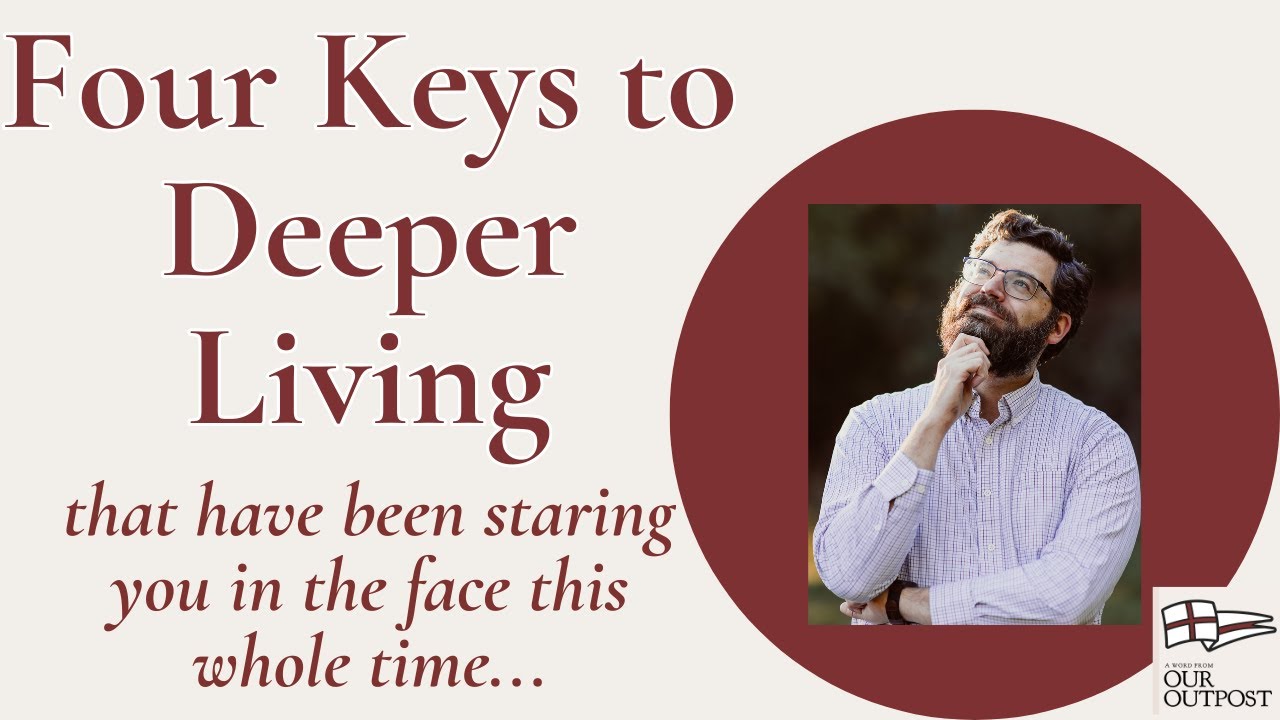
Episode 257 · 18 min · With Joseph Gruber
Four Keys to Living Deeply
Take the Our Outpost Quiz
A free four-minute self-assessment for Catholic couples and singles. Tell us who you are, answer a few questions, and get personalized results emailed to you, with at least one way we at Our Outpost can help you answer the call of matrimony.
Take the Quiz →Key takeaways on living deeply
- Depth over length. Some live a richer life in 20 years than others do in 80. If today were our last, depth is the only thing we could add.
- Sin is shallow. Sin takes something meant to be deep and meaningful and flattens it into something much less.
- Think and speak more deeply. Think with the mind of Christ, and ask whether your words today glorified God and dignified your neighbor.
- Choose the best, and plan for it. Confession invites us to see the better option we missed and to have a plan for choosing it next time.
- Practice virtuous omission. Instead of omitting good things, cut out the clutter: say “not now” or “no, thank you” to what doesn’t serve your mission.
“Trying to be a saint is living a deep life of love of God and love of neighbor.”
Joseph Gruber
Try this this week
Tonight, run a quick Confiteor check:
Where did my thoughts and words go deeper today, and where did they stay shallow?
Pick one thing to omit tomorrow so there is room for something better.
Chapters
- 0:00 Do you want a deeper life?
- 0:56 Opening prayer
- 1:29 Three men at a funeral home
- 2:50 Trading depth for length
- 3:17 A richer life in 20 years than in 80
- 4:56 If today were our last day
- 5:21 Sin is shallow
- 6:15 Four areas from the Confiteor
- 6:55 Deeper thoughts
- 8:30 Deeper words
- 9:07 Choosing the best in what we do
- 10:54 What we fail to do, and a virtuous omission
- 12:45 Saints of every lifespan
- 13:41 Far too easily pleased
- 15:46 Quiet depth beneath the surface
- 16:55 Closing prayer
Mentioned in this episode
- The Confiteor from the Mass
- The Weight of Glory by C.S. Lewis
- Doctor Who, from the David Tennant years
As an Amazon Associate, Our Outpost earns from qualifying purchases.
Full transcript
Do you want a deeper life?
0:00 Do you wanna live a life of greater depth, of greater intensity, of greater love? Listen in to find out more. Real quick, my wife and I do run a nonprofit called Our Outpost Marriage Ministry, Incorporated. It has as its mission to awaken authentic Catholic culture through holy matrimony. We think that matrimony is one of the two
apostolic sacraments of the Catholic Church ordered to the salvation of others. First, the spouse, and then the rest of the world together with the spouse. We think that your spouse is your permanent teammate as well as your permanent mission field. And we wanna help you in both of those kinds of ventures, in loving your spouse and in loving the world together.
We also want to help Catholic singles find wives or husbands as the case may be. So if you’re interested in supporting this work, you can check out our giving page that’s going to be linked in the description. Really appreciate you being here and on with the show.
Opening prayer
0:56 Welcome to A Word from Our Outpost, with Joseph and Crystal Gruber — a podcast for Catholic disciples who are wrestling to be missionary-minded in their normal and everyday lives. In the name of the Father, and of the Son, and of the Holy Spirit. Amen. Direct, O Lord, our actions by Thy holy inspiration,
and carry them on by Thy gracious assistance, that every word and work of ours may begin in Thee, and by Thee be happily ended. Amen. In the name of the Father, and of the Son, and of the Holy Spirit. Amen. Hello and welcome to A Word from Our Outpost. I am Joseph Gruber, host of this podcast,
founder of Our Outpost Marriage Ministry.
Three men at a funeral home
1:29 I want to tell you a story about three men who go to a funeral home for their fourth friend to pay their respects. And as they’re gathering around the casket, they get to talking and they say, you know, he was taken before his time. They say the nice things about the dead. And then they ask the question,
what do we wish people would say about us if we were laying in a casket in the funeral home? And the first one started and he said, you know, I want them to know and to remember me as a hardworking man, as a man who did what needed to be done, who was unflinchingly loyal
and trustworthy and industrious. I want them to speak of my work ethic and my general ethos in life. And the next guy, he said, I want people to speak of my relationships about how caring I was, how awesome I was as a husband and as a father. That’s what I want them to be talking about,
the kind of friend that I was. And the third man, he says, when they see my body laying out there, what I want them to say is, oh my goodness, he’s moving. And this is the joke, right? That’s the joke. And why is it a joke? You explain a joke to kill it.
I’m gonna explain the joke, ladies and gentlemen. Dear listener, I’m going to explain the joke.
Trading depth for length
2:50 It’s a joke because the last man decides he wants to trade depth for length. He wants a long life and he’s not concerned about the depth. And it’s jarring, right? Like that’s one of the things about jokes. They take you one direction and then switch you to a different direction, an unexpected direction.
And that’s the unexpected direction to exchange depth for length. My wife and I,
A richer life in 20 years than in 80
3:17 with our oldest son, we were watching through Doctor Who. Don’t know if you guys are familiar with that as a show, but we’re in the David Tennant years of Doctor Who. And there was an episode recently that we watched and by recently, recent in our timeline, not on anybody else’s timeline. Anyway, about a man who found a way
to reverse the aging process. And so he could conceivably, potentially restart his life multiple times over if the technology worked quite right. Which, spoiler alert, it doesn’t. Anyway, the doctor who has lived an indeterminate amount of time and occasionally regenerates as needed. Not very sure how that process works, ladies and gentlemen, yet.
I’ve only seen one regeneration. So still learning the ropes on that. But they have this discussion about how, you know, a man can live a richer life in 20 years and some men can live in 80 years. In this discussion, like, length is not the thing that is most necessary. Which got me to wondering, what is the thing?
And it occurred to me, if it’s not length, it’s probably depth. And if you’re watching the YouTube video of this, I made a gesture across and a gesture down to emphasize depth. But, statistically, you’re probably listening to this. Anyway, depth. What do we mean by depth? What do we want in terms of a deep life?
Or, like, richer life? And I think this is really important.
If today were our last day
4:56 I think if today were our last day, if this is the last day that we have and we don’t have any more length after this day, what would we need in order to maximize its value? We can’t extend the length. All we can do then is extend the depth. And that got me to thinking,
you know, this is more metaphorical by analogy. But what are things that are deeper and what are things that are shallower?
Sin is shallow
5:21 Well, the most shallow things are going to be the things that are sinful. Sin is a superficial thing. It’s a superficiality. It is a shallow thing. It is taking something that ought to be deep and meaningful and reducing it to something much, much less so. It is the warping, the compressing, and the excluding of that which is right and proper
for the sake of something that is not right and improper. So what then would be deep? And I think fundamentally we’re talking here about the love of God and the love of neighbor. These are the two most deep things. These are the deepest touchstones in our life. When we expand our hearts and our love of God
and expand our hearts and our love of neighbor, we get to experience deeper living. And so what are four categories that we could focus on and
Four areas from the Confiteor
6:15 for this I’m going to pull from the Confiteor. There are four things that can be more or less superficial, more or less deep that we talk about most every Sunday and more major feast whenever we do recite the Confiteor or whenever the priest decides to do it. And these would be in our thoughts and our words
and what we have done and what we have failed to do. And I think these are areas to consider today.
Deeper thoughts
6:55 What am I doing to have deeper thoughts? What is a deeper thought? When I’m actually considering, well, there’s like a couple of different directions you can go with this, but fundamentally to think with the mind of Christ, to think with God, to consider the world from God’s perspective, to consider ourselves from God’s perspective,
to consider our life, our choices from God’s perspective, to think that way. Versus thinking without him, thinking with the mind of the world, thinking with the mind of whichever podcaster you’re listening to currently, which is me by the way, by definition, the podcaster you’re listening to right now is me. And so I guess you better hope and pray
that I’ve been praying at least some in the last who knows how long. Okay, so our thoughts and these, our thoughts can become all sorts of twisted and repetitive, they can become obsessive about things that are evil, about temptation, about niggling things. And so this is an invitation to deeper thought, to say, okay, how can I view these things in my life
with the mind of Christ? He is here right now. He is actually thinking and loving in this moment at all times and at every place, at every time and at every place, God draws close to man, which means he’s thinking about me, about my circumstances, and he’s inviting me to think alongside of him,
to have a renewal of our mind. This is a thing that we can do. So we can have a deeper life based on our thoughts, we can have a deeper life based on our words. And particularly, we should be asking the question,
Deeper words
8:30 do I speak to glorify God? Do I speak to dignify my neighbor? Am I doing that? Is that what my speech is being used for? If somebody were to hand me a transcript of my speech today, would I be able to look through it and circle all the places where I’ve been glorifying God by my speech,
where I’ve been dignifying my neighbor by my speech? This is something that we can work on. This is something that would allow for greater depth. This is something that would allow for greater meaning in my life and in your life and in the lives of those we love. And then what we do,
Choosing the best in what we do
9:07 when we come to a moment of decision where we have choices arrayed before us, we have to choose between the best option and good options and bad options. Do we choose the best? Do we choose that which is most going to serve God and neighbor, which is most going to accord with our mission in life?
Or are we choosing something lesser? This is one of the crazy things that struck me years ago about the great thing that the Church does in asking us to confess our sins. Because the church is saying, look at what you’ve done and really consider that wasn’t what you were supposed to be doing.
There was something else that you could have done in that moment. There was a better option. There was always a better option when we sin, right? And sometimes it’s very clear like I should have just walked away or I should have just closed the laptop or I should have apologized. Whatever it is, there is a next step
that was better than the one that we took. And the real trick is to say, how can I take that next step now, going into the future, right? One of the things about going into confession is, do I have a plan for how I would do better next time I come to this point of decision?
Because if I don’t have a better idea of what I wish that I were doing, when I get to that point of decision, again, I’m probably going to make the same decision. Again, I’m going to choose the lesser thing again, unless I came up with a better idea. If I came up with a better idea,
to be mindful of that, to actually inculcate a desire for that greater thing and to long for that greater thing and to choose that thing.
What we fail to do, and a virtuous omission
10:54 Okay, what we do and then what we don’t do, right? So are there sins of omission, things that we’re not doing that we ought to have done? Are we putting off some good that we ought not to put off? And I think this is a hard thing for us to really wrap our heads around
because you can get all sorts of scrupulous when it comes to thinking about this, saying, well, there’s a million things that I could do. There are a million phone calls or text messages I could make or emails or books that I could read or poetry that I could memorize or scripture that I could commit to memory.
I could be designing something and that’s not what the sin of omission is about. The sin of omission is this idea like, oh, there was a good that I knew that I was supposed to do and I didn’t do it. And if I didn’t know that I was supposed to do it, can’t really be all that culpable for it.
To say, okay, then can I make my life deeper by not doing things, right? Instead of confessing the sins of omission, can I have a virtuous omission? Can there be things that I don’t do that I otherwise would have done? Things that I can say no to that I otherwise have said yes to?
Can I omit the bad things instead of omitting the good things, right? The kind of depth that comes from just cutting out a lot of the, I don’t know, crap in our life that we don’t need, we didn’t need, that is cluttering our heads and our hearts, cluttering our day, our schedule, that we’re allowed to cut things,
that is okay to say to this thing, not now or no, just no, no thank you. Gentlemen,
Saints of every lifespan
12:45 saints, they came in all sorts of lifespans. Some lived for 20 some years, some lived for 80 some years and anything in between, some were child martyrs, some were, we got to witness the ravages of old age. The question is not whether they lived longer than anyone else. The question is how deep was their life?
How deeply did they live? Ladies and gentlemen, we can live deeper lives. We can live a life that has depth in what we think and say and do and not do, that an account could be made of our life today where we have greater depth than the day before. And the problem is, most of us don’t do this.
Most of us will not take the time it takes to really look at what we’re doing and to say yes and to say no as appropriate because we’re, I don’t know, there are a lot of different reasons.
Far too easily pleased
13:41 C. S. Lewis talks about this, right? He talks about this, I think it’s in The Weight of Glory, but I’ve broke down the quote. Yeah, The Weight of Glory. “We are half-hearted creatures, fooling about with drink and sex and ambition when infinite joy is offered us, like an ignorant child who wants to go on making mud pies in a slum because he cannot imagine what is meant by the offer of a holiday at the sea. We are far too easily pleased.” This idea, we don’t know what deep living is
until we look at the lives of saints. We don’t know what deep living looks like until we look upon Christ on the cross. And so what we’re left with is examples of superficial living, right? And this was one of the greatest disappointments in that Doctor Who episode that I referenced earlier, right? This guy who had committed to trying to regenerate himself,
to rejuvenate himself, he ends up taking a sanctuary in a cathedral. And instead of pointing out that there was a man who by rights could have lived forever because he was untouched by original sin, the perfect man, he willingly embraced a shorter life that we might know the depth of his love. They had that opportunity,
but obviously Doctor Who is not the most Christian of storytelling. So there’s that little bit of lament that they did not conquer by way of the cross in that particular episode. They did conquer by way of music, which is something, but it is not the way of the cross. Ladies and gentlemen, dear listener,
we are called to deeper living. We are called to a deep life. We can do this. By God’s grace, for his glory, we can do this. We have one life to live. We have one mission to live out. And fundamentally, that’s a mission to be a saint. Oftentimes we think about, oh, I don’t wanna be a saint
because I don’t wanna be going after, you know, the glory of the saint or I don’t want to be trying to convince people of my holiness. And that’s not what trying to be a saint is.
Quiet depth beneath the surface
15:46 Trying to be a saint is living a deep life of love of God and love of neighbor. And the deeper the life, the more holy the life. And that’s what we’re called to. We’re called to great depth. And the cool thing about that depth, we don’t have to worry about people taking notice
because a lot of that is just gonna be taking place under the surface. The depths that we are called to will not be seen probably in our lifetime. And that is perfectly okay. That is the kind of life that we are called to live. That is the kind of life that so many of the saints got to live out.
Is one of quiet depth and depth that went way under the surface. That comes out when we are uprooted by death, then people can see the roots that we’ve planted. But until then, we get to choose, are we just trying to live a really long life or are we trying to live the deepest life possible?
That is the episode.
Closing prayer
16:55 As always, you can rate and review and share on Apple Podcasts and Spotify and YouTube and all of that. That’s always appreciated. I’m trying to think if there’s any other kind of announcement at the end. I don’t think so. You can check out our work at ouroutpost.org. That’s probably worth doing. But in the meanwhile, please pray for us.
We’ll be praying for you in the name of the Father and of the Son and of the Holy Spirit. Amen. Glory be to the Father and to the Son and to the Holy Spirit as it was in the beginning is now and ever shall be world without end. Amen. In the name of the Father
and of the Son and of the Holy Spirit. Amen. From Our Outpost to yours, thanks for listening and a special thanks to JohnMarc Skoch for the music. Check him out on Spotify.
Keep listening
Share this episode
Know someone who wants more than a long life? Send this their way.