
What would it cost you to let go of your most prized possession? Joseph Gruber looks at holy detachment through his own shelf of Gene Wolfe novels, the Principle and Foundation of St. Ignatius of Loyola’s Spiritual Exercises and the final scene of Schindler’s List, and asks whether our possessions have started to possess us.
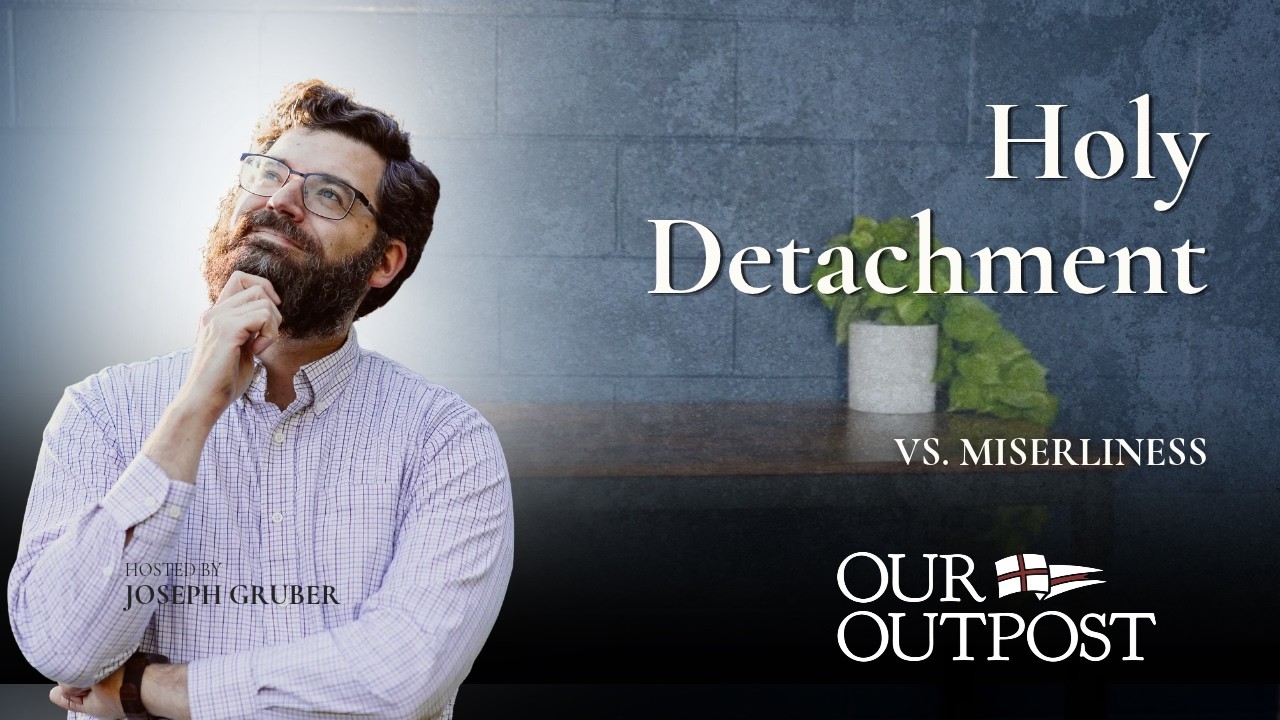
Episode 300 · 22 min · With Joseph Gruber
Holy Detachment or Miserliness
Take the Our Outpost Quiz
A free four-minute self-assessment for Catholic couples and singles. Tell us who you are, answer a few questions, and get personalized results emailed to you, with at least one way we at Our Outpost can help you answer the call of matrimony.
Take the Quiz →Key takeaways on holy detachment
- Name your most prized possession. Then ask what it would cost to lose it. For Joseph it’s a shelf of Gene Wolfe novels and a cozy birthday blanket, and he isn’t sure he could let them go, which tells him something about his own detachment.
- We hold on for good reasons and bad ones. A desire for security, pride of ownership and never having to rely on anyone are antisocial, even anti-saint. A book or a boat can also make us better readers or better neighbors, so the question is whether a thing is shaping us into saints.
- Use created things only as far as they help. St. Ignatius teaches that we are created to praise, reverence and serve God, and that everything else is for helping us reach that end. Hold the things of this world with open hands, knowing we can’t take any of it with us.
- Nobody told us we have to keep it. Savings, a retirement plan and an emergency fund are fine. But if our security rests merely in possessions, it’s time to rethink. If they broke, were stolen or someone needed them, how quickly could we let go?
- Don’t walk away sad like the rich young man. Churches, schools and ministries often wonder whether the ends will meet. We don’t want to reach our deathbed wishing we had sold the boat sooner to support a good work God placed on our hearts.
“Wouldn’t it be a shame that our miserliness kept us from true generosity?”
Joseph Gruber
Sit with this in prayer
Two questions to bring to the Lord this week.
What is my most prized possession, and what would it take for me to give it up?
If Jesus asked me for it, what would hold me back?
Chapters
- 0:00 Opening prayer and welcome
- 0:49 My most prized possession
- 2:01 Should I sell the books?
- 2:45 The extra coat in your closet
- 3:33 Why we hold on to things
- 5:20 The boat in the driveway
- 7:18 The Principle and Foundation of St. Ignatius
- 8:51 What the stuff of the world is for
- 9:46 When our possessions possess us
- 10:04 Nobody told us we have to keep it
- 10:53 Savings, security and repentance
- 12:16 Beautiful churches and what we’d give
- 13:17 One more life
- 15:04 Our time, talent and treasure
- 16:46 The rich young man
- 18:04 Miserliness or generosity
- 19:22 Blessing others with what we have
- 20:43 Supporting Our Outpost and closing prayer
Mentioned in this episode
- St. Ignatius of Loyola, the Principle and Foundation of the Spiritual Exercises
- Matthew 19:16–22, the rich young man
- Gene Wolfe, The Book of the New Sun and his other novels on Joseph’s shelf
- Schindler’s List and its final scene
- ouroutpost.org, where you can support the work of Our Outpost
- The Our Outpost Quiz, four minutes for Catholic couples and singles
Full transcript
Opening prayer and welcome
0:00 What if we lived with a holy detachment? Listen in to find out more. Welcome to A Word from Our Outpost with Joseph and Crystal Gruber. A podcast for Catholic disciples who are wrestling to be missionary-minded in their normal everyday lives. In the name of the Father and of the Son and of the Holy Spirit.
Amen. Direct, O Lord, our actions by thy holy inspiration and carry them on by thy gracious assistance that every word and work of ours may begin in thee and by thee be happily ended. Amen. The name of the Father and of the Son and of the Holy Spirit.
Amen. What if welcome to A Word from Our Outpost. What if we lived with holy detachment? And before I go any further in this episode, if you want to support our work, you’re welcome to do so. I believe there will be a giving link, a donation link to our 501c3 nonprofit. Moving on, talking about holy detachment from stuff.
My most prized possession
0:49 Take a moment and think, what is my most prized possession? What is the thing that I am most glad to own that I take most satisfaction in owning? For me, I thought about this for a little while before I pressed record and I realized one of the things that I’m really glad to own is I have most of the works of the author Gene Wolfe.
I have a shelf in the basement that is almost entirely Gene Wolfe. From The Book of the Long Sun to The Book of the New Sun to The Book of the Short Sun to Pirate Freedom and devil in the forest and Home Fires and a lot of things that I don’t really understand but I have them.
I own them. They are mine. And I was reflecting on this like what would it cost for me to lose them? Like what what would what is the bar for me to hold on to them? because I could sell them.
Some of them are in great shape and there are a lot of Gene Wolfe, maybe not a lot of Gene Wolfe afficionados out there, but there are some Gene Wolfe fans out there. And so, why don’t I sell them? This is a good question.
Should I sell the books?
2:01 Do I actually need to have a shelf of Gene Wolfe books or should I give them away or sell them and use the proceeds to further the mission of the church? And I’m not sure. I don’t know. which makes me realize I probably don’t have a holy detachment from my stuff.
I mean, my my stuff is like a shelf of books. That’s the stuff that I’m talking about. The other thing that I own that I really prize is a really cozy blanket that I got for my birthday last year. I I really like that blanket. It’s really cozy.
The extra coat in your closet
2:45 But but this is the kind of stuff that I’m talking about uh in terms of my own life, what I hold on to, what I prize, what I value, what I’m glad that I own. and then thinking could I go without it what would what would it cost for me to go without and am I willing to pay that price like what what is the other side of that scale and the other side of that scale that’s the question that this is the thing when when the church fathers say like the extra cloak that you have the extra coat that you have in your closet the fact that you’re keeping this and not giving it away when you don’t need it means that you’re keeping it from someone who might need it.
Which means that you don’t have the kind of holy detachment that the church fathers are talking about. I don’t either. I also have more than one coat. Maybe not a lot more than one coat, but more than one coat. And I can’t wear more than one coat at a time. That’s one of the things about coats.
Why we hold on to things
3:33 And and so there’s this question, why do I have this stuff? Part of it is like a a desire for security. Uh part of it is a kind of pride of ownership. uh the the delight in having control and access to these things, not relying on other people for them, being self-sufficient in these respects.
Like I don’t have to ask anyone for a Gene Wolfe book because I own a lot of them, which means I don’t have to talk to people about uh requesting them from a library or requesting them from another friend who might have a more expansive library than I do. uh and and and so these are these are antisocial elements.
These are not only antisocial elements, they are antihuman elements. They are anti-saint elements. These are these are elements that I’m holding on to that are not contributing to me becoming holy. Whether or not I should give away or sell my Gene Wolfe books, I’m not entirely sold one way or the other.
But I do want to bring this up because this notion of am I holding on to things for no good reason and only bad reasons. Part of the reasons I’m holding part of the reason I’m holding on to the Gene Wolfe books is that his work delights me and confuses me and I hope to one day understand his work.
And so maybe there’s that element of well I I own these books for a good reason as well. It’s not just pride. It’s not just control. It’s not just a sense of accomplishment anytime I look at the shelf, but it’s also a sense of challenge and me wanting to become a better and more literate reader.
And that’s something that Gene Wolfe, this is not a podcast about Gene Wolfe. Just in case everybody was confused at this point, is is Joseph only going to talk about Gene Wolfe? Is he not going to offer any other more realistic examples?
The boat in the driveway
5:20 I can offer more realistic examples. I can say the boat that you have in your driveway or the RV or the really fancy car or the really fancy clothes that you don’t wear or that you only wear in order to show off. I I could say like the the really expansive liquor cabinet.
I could say I could say I don’t actually need to say all of these things because the ones that are relevant are the ones that you’re thinking of. the the ones that are relevant are the ones that you have been thinking of.
Every time that I’ve been wandering off to talk about Gene Wolfe, whatever you’ve been thinking of that you own, that’s the thing that matters. I don’t know that. I know that if I listen to this later, I’ll be like, “Yeah, Joseph, those Gene Wolfe books, is it just because you want to be a more literate reader, or is it because of all this other stuff, or is it a combination?”
And in so far as it’s a combination, I I need to examine and and let go and surrender and to develop a sense of of holy detachment from stuff. I’m not going to take these books with me to heaven. These books are only valuable in so far as they shape me to be a better person.
In so far as they are shaping me to be a worse person, I need to get rid of them. But if they’re shaping me to become a better person, I should hold on to them.
It’s like the boat that you own maybe is shaping you to be a better person, a more conscientious person, a more inviting person, a more hospitable person. Maybe it’s the access point by which you can interact with your neighbors around a lake, which is a very common thing in the state of Michigan and maybe some other states that have a lot of lakes.
Maybe the boat is a great conversation starter or access to a whole community of people that you feel God is calling you to reach out to. That is possible. But in so far as it is warping you, then it’s it becomes problematic. Then then it becomes something that is endangering our soul.
The Principle and Foundation of St. Ignatius
7:18 And the the best way that I’ve seen this be captured, this this dynamic of treating the things of this world rightly, I came across this many years ago with the the spiritual exercises of St. Ignatius of Loyola. This is the principle and foundation of the spiritual exercises.
I’m going to read it for you. I got some good feedback when I read the St. Augustine chapter. So I’m going to read this as well. So the principle and foundation of St. Ignatius of Loyola’s spiritual exercises.
Man is created to praise, reverence, and serve God our Lord and by this means to save his soul. and the other things on the face of the earth are created for man and that they may help him in prosecuting the end for which he is created.
From this it follows that man is to use them as much as they help him on to his end and ought to rid himself of them so far as they hinder him as to it.
For this it is necessary to make ourselves indifferent to all created things in all that is allowed to the choice of our free will and is not prohibited to it.
So that on our part we want not health rather than sickness, riches rather than poverty, honor rather than dishonor, long rather than short life, and so on in all the rest. desiring and choosing only what is most conducive for us to the end for which we are created. That’s it.
What the stuff of the world is for
8:51 That’s what the stuff of the world is for. If it’s shaping us to become the saint that we’re called to be, then we should hold on to it with open hands, knowing that we’re not going to be able to hold on to anything at the end.
And if it’s shaping us to become grasping, if it’s shaping us to become controlling, if it’s shaping us to become prideful, that’s worth talking to our Lord about. That might even be worth making a a a separation, a sacrifice, a gift of the thing that is holding us back.
Wouldn’t it be a shame if there was one thing that we owned that was the difference between us becoming the saint that we’re called to be and us just being a poor schlub?
Wouldn’t it be a shame that we were holding on to something that we thought was so precious and in the end is a thing that was holding us back from eternal glory? Wouldn’t that be a shame?
When our possessions possess us
9:46 Wouldn’t it be a shame that our miserliness kept us from true generosity? that the possessions that we thought we possessed were actually possessing us. Wouldn’t that be just a horrific horrific turn of events and preventable? This is the thing. This is the thing about the stuff that we have.
Nobody told us we have to keep it
10:04 Nobody has told us we have to keep any of it. Nobody has said, “Hey, that gift that you received 10 years ago, you better make sure you still have it.”
This is the whole like the white elephant thing that the the king made a gift of a white elephant to one of his nobles that he didn’t really like and the nobleman had to feed and house this elephant and it it bankrupted him.
This idea that the gift itself was uh worked its poison on on the the recipient. And we don’t actually have to live that way. That that’s not the dynamic for almost any of the stuff that we own. All of the stuff that we own, we shouldn’t grasp onto, we can let go of.
Savings, security and repentance
10:53 We I’m not saying that we can’t have savings. I’m not saying that we can’t have a retirement account or a plan for the future. I’m not saying that we shouldn’t have an emergency fund. That’s not what I’m saying.
I am saying that if we think that our security is merely in possessions then we are wrong and we should rethink our life. This is a process of metanoia. This is a propos pro process of of repentance. This is a process of ongoing change and transformation in Christ that our possessions should not possess us.
If if they broke, if they were stolen, if somebody had need of them, how quickly could we let go? How long would we hold on to them? This is the question we should have. If a fire ripped through our house and all of our trophies were melted, can we move on?
Would we be pining after the the expensive bottles of scotch and the fine mahogany furniture and the the leatherbound books? Are these the things that we’re going to hold on to and mourn their loss? Or are we going to mourn the fact like could we not yet give more for the salvation of souls beginning with our own? Could we not give more for the building up of the kingdom?
Beautiful churches and what we’d give
12:16 This is a question sometimes I think about uh looking at really beautiful churches that were built a 100 plus years ago and think is the community there now such that if this church were destroyed would they be able to would they be willing to give what is required to rebuild the beauty to restore the beauty and sometimes not sometimes we are inheritors of something that we would not have sacrificed for and And that’s an that’s an interesting place to be in.
That is a that is a weird place to be in because in point of fact, if we’re doing our jobs right, we should be actually aiming to build more churches because we’re living such lives of generosity and uh evangelical zeal and and joy that people are coming into the church such that we need more buildings, new buildings, renovated buildings, restored buildings.
This should be something where we are delighted to make a gift of our time, our talent, our treasure for the building up of the church.
One more life
13:17 This was one of the scenes uh at the very end of Schindler Schindler’s List. And I know some people have problems with this movie because it’s like the one good story of somebody trying to do something right amongst the Nazis and people are I mean there’s a lot of things, right?
But the the final scene when when Liam Neeson’s character is like, “Oh, you know, if I had if I had sold this this pin, I probably could have saved one more life. I could probably have saved one more life if I had gotten a cheaper suit.
I could have saved one more life.” Like, how many lives are hanging in the balance by his possessions? And then you could also weigh like, well, if you got rid of too much stuff, people would have suspected that you were acting out of sorts from a Nazi.
All of that. But the that that that that moment that should pierce us as Catholic Christians, that should pierce us as men and women who know that there is a mission, who know that there are souls out there who long for truth and goodness and beauty found most gloriously in Holy Mother Church provided by our Lord and Savior Jesus Christ.
And like what what would be we be willing to give in order for this message to to reach a little further? What could we give of our time, our talent, and our treasure for me more people to come to know the truth and the freedom that comes in Christ. Like we we should have that same sort of sense.
Our time, talent and treasure
15:04 We don’t want to go to our deathbed saying, “Oh, if only I had sold the boat earlier, I could have supported this good work. I could have started this good work. I could have supported this family who was in need.
I could have supported this church that had this this very particular need or this very general need, right? Like one of the things I so my wife and I, we run a marriage ministry. I’m also on the board of a classical uh academy high school here in town.
And one of the issues for both is is always the matter of funding. These are beautiful things that are that we’re working on. These are beautiful things that we’re trying to do. And the question is will there be people to fund this work?
Does it actually attract fund funds such that the work can be done? And sometimes the answer is not quite. There there are often times that we look at each other either for the school or for the marriage ministry and be like, “All right, will the ends meet this time?
How will the ends meet this time? And what if more of us lived an abundant life and a more generous life such that we were supporting more of the good things that we enjoy?” Now, I’m not saying that anybody who’s listening to this podcast has to donate to this podcast.
I am saying that it’s an option. So, if you if you wanted to sell that pin or exchange your fancy suit for a slightly less fancy suit or get rid of that boat and make a donation to Our Outpost, you’re welcome to.
If you want to support the chest the the uh the Chesterton Academy of St. George, you’re welcome to support that as well.
The rich young man
16:46 Uh but I am saying that whatever it is that God has placed on your heart to support, to contribute toward, to volunteer at, if you’re possessions are getting in the way of following the will of God, don’t be like the poor rich man who walks away sad because he had many possessions.
He he was wealthy in the world and impoverished in spirit because he was not willing to sell all that he had to give to the poor and to come and follow Jesus. That was a very particular call to a very particular man. But many of us there is a sense I could be selling more.
I could be giving more. The the income that I have is such that my outcome could actually influence this world more for the better. rather than just for my own benefit. Not that your benefit is a bad thing. I actually like most of the people who listen to this podcast, I think.
And I I desire all of your good. That is a thing. So having part of the outcome of your income being your good, I am totally in support of. But this question of is it is it such that it appears to be for my good, but I’m actually using it for my own destruction?
Miserliness or generosity
18:04 Are my possessions starting to possess me? That is a sign of miserliness versus a spirit of liberality, generosity, giving. And it’s something it is something to ponder. It is something to address.
I will be talking with uh the group of men that I lead on Saturday mornings um actually like four or five days before this episode goes out. And this will be something we’ll be talking about. What is your most prized possession? What would it take for you to give it up?
Would you give it up if Jesus asked you to? Not saying that he is, but if he did, what would hold you back from it? What would hold you back? Because that that thing that’s holding you back, that is something that needs to be inspected.
That is something that needs to be uh examined and and and questioned. Why would this hold me back? I’m not going to keep this prized possession forever. And if I still own it when I die, where is it going to go to after that?
Who will it benefit? Or is it just going to be stuck in what is it? Like an appeals court or something like that? Not appeals. That’s not the right word. Probate. I think probate.
Blessing others with what we have
19:22 Anyway, it’s been a while since I’ve had to look into like the the the law around wills and all the like all the like, but but we have these opportunities to bless other people with our possessions, to make gifts more and more often.
And we don’t. And the less we do, the more constrained our hearts are. And then the things on the face of the earth that are created for man that they may help him in prosecuting the end for which he is created, we’re not using them to help us onto our end.
We are not ridding them in so far as they hinder us as to that end. And that’s a problem. This is something worth examining. This is something worth talking about with a friend, family member, spouse.
This is something worth talking about with your pastor. some something worth talking about with your favorite nonprofits saying, “I have too much stuff and I want to get rid of some of it. I have too many possessions and I don’t want them to possess me.
I have too much money and I want it to do good in this world and it’s not doing the good that it’s supposed to yet, which is doing me badly. The the lack of generosity in my part is actually hurting and it’s time for that to change.” All right.
Supporting Our Outpost and closing prayer
20:43 And then again, if you are interested in supporting Our Outpost, there is a link to donate. You are welcome to become a monthly donor if you like. That would be delightful. Be great to have you on this mission. And check out ouroutpost.org because we have a lot of stuff there.
Share this podcast especially with the people who you know are really rocking the whole possessions not possessing them thing because you can say, “Hey, I thought of you.” Because you’re a great example of your possessions not possessing you and then they’ll feel happy that you shared.
That’d be a great little gift to them. All right, that is basically the episode. My thanks to you. It’s good to be with you. You could be anywhere. You could be doing anything and you decided to let my voice accompany you. And isn’t that a little that’s that’s delightful.
Thank you. All right. Please pray for us. We’ll be praying for you. In the name of the Father and of the Son and to the Holy Spirit. Amen. Glory be to the Father and to the Son and to the Holy Spirit. As it was in the beginning, is now and ever shall be, world without end.
Amen. Name of the Father and of the Son and of the Holy Spirit. Amen. And now finally from our outpost to yours. Thanks for listening and a special thanks to JohnMarc Skoch. That’s sk for the music. Check him out on Spotify.
Keep listening
Share this episode
Listen with a friend, then ask each other: what would it take for us to give up our most prized possession?