
What do we do with Job and the character of God? Joseph talks with his brother Deacon Jacob Gruber, weeks before his priestly ordination, about a paper Jacob wrote on the Book of Job. They resist reducing Job to a tidy moral, face the uncomfortable picture of God in the opening chapters, and trace a pattern in Genesis where being chosen means suffering for the sake of others.
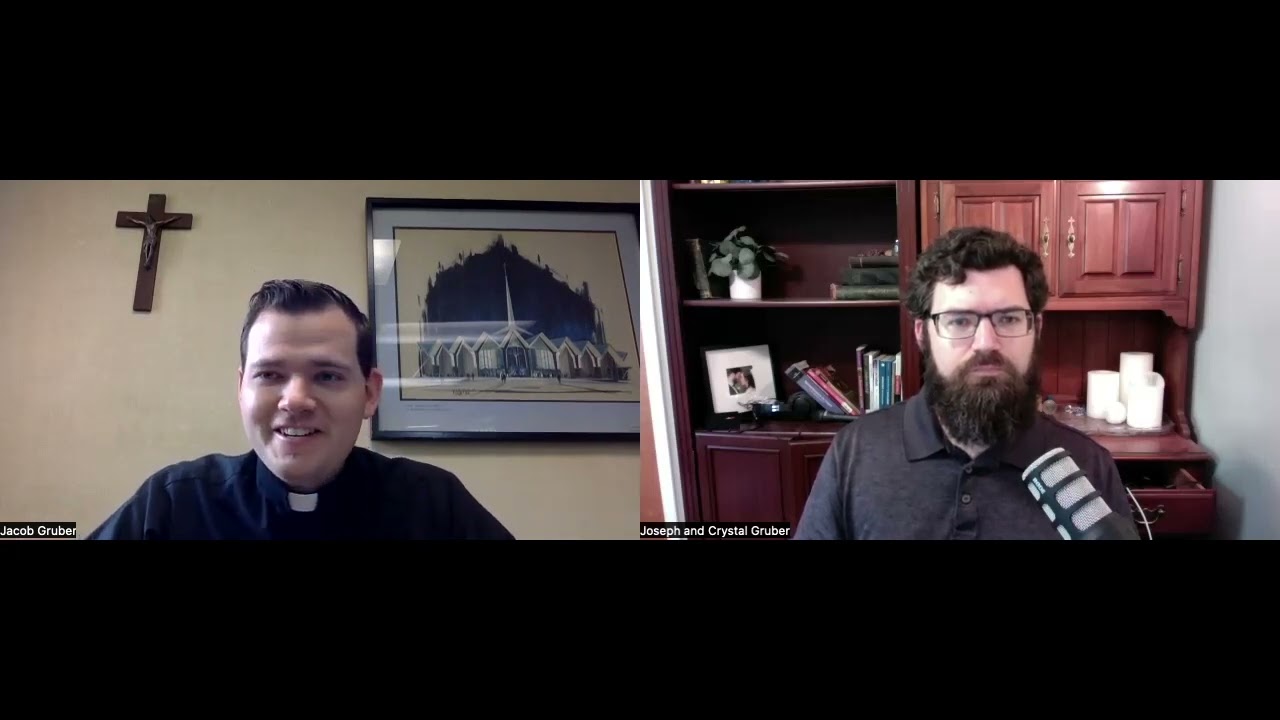
Episode 159 · 41 min · With Joseph Gruber and Deacon Jacob Gruber
Job and the Character of God and the Pattern of Being Chosen, Part 1 with Deacon Jacob Gruber
Take the Our Outpost Quiz
A free four-minute self-assessment for Catholic couples and singles. Tell us who you are, answer a few questions, and get personalized results emailed to you, with at least one way we at Our Outpost can help you answer the call of matrimony.
Take the Quiz →Key takeaways on Job and the character of God
- Job is more than a moral. Like Aesop’s fables with a lesson tacked on, it’s tempting to reduce Job to one point. Jacob calls it a polyphonic text, with many voices doing different things.
- Everyone in Job assumes a just world. Job’s friends insist that the good are rewarded and the bad punished, so Job must have sinned. Job assumes the same and concludes that something has gone wrong with God.
- The opening is uncomfortable, and that’s okay. God says Satan incited him against Job for nothing. Calling it just a story, accepting a capricious God, or ignoring it all fall short.
- Being chosen often means suffering for others. Joseph in Genesis is favored, nearly killed and raised up, and through him bread reaches the whole world. What his brothers meant for harm, God meant for good.
- Faith is a kind of sight. Abraham and Isaac went up the mountain together. Faith isn’t blind. It has seen enough of God’s goodness to trust him with a blank check.
“Faith is seeing beyond what your human eyes can see, what your intellect would give you normally.”
Deacon Jacob Gruber
Sit with this in prayer
Two questions to bring to the Lord this week.
Where do I expect God to run the world by my rules?
What blank check might God be asking me to sign right now?
Chapters
- 0:00 Opening prayer and welcome
- 0:52 Deacon Jacob, almost a priest
- 3:36 Why Job, and why now
- 5:15 More than a moral
- 6:05 Aesop’s fables and a polyphonic text
- 11:05 The just world theory
- 12:54 An uncomfortable picture of God
- 15:37 “You incited me”
- 17:56 Door one: it’s just a story
- 20:07 Door two: a capricious God
- 22:26 Doors three, four and five
- 25:45 The favorite son in Genesis
- 28:57 Chosen for the sake of all
- 31:34 What you meant for harm
- 32:21 Abraham and the pattern
- 38:12 Isaac, the willing victim
- 39:49 Faith is a kind of sight
- 40:20 To be continued
Mentioned in this episode
- Job 1–2, the opening of the Book of Job
- Genesis 37 and Genesis 50:20, the story of Joseph
- Genesis 22, the sacrifice of Isaac
- Mortimer Adler, How to Read a Book
- The Office of Readings in the Liturgy of the Hours
As an Amazon Associate, Our Outpost earns from qualifying purchases.
Full transcript
Opening prayer and welcome
0:00 Hey, Jacob. Hey, Joseph. Do you want to talk about Job and how God maybe is really cavalier and really, really horrible? Or maybe this other thing that you wrote a paper about where he’s not that. I think we should talk just about that very thing, Joseph.
Listen in to find out more. Welcome to A Word from Our Outpost, with Joseph and Crystal Gruber — a podcast for Catholic disciples who are wrestling to be missionary-minded in their normal and everyday lives. In the name of the Father, and of the Son, and of the Holy Spirit.
Amen. Direct, O Lord, our actions by Thy holy inspiration, and carry them on by Thy gracious assistance, that every word and work of ours may begin in Thee, and by Thee be happily ended. Amen. In the name of the Father, and of the Son, and of the Holy Spirit.
Amen. Hey, Jacob. Hey, Joseph.
Deacon Jacob, almost a priest
0:52 Did you see how I tucked your name into the intro there? I think that people aren’t even going to notice. Seamless. Yeah. I wish I had thought of it the other times we’ve had you on. The power of editing. I didn’t edit anything.
I just said your name instead of, or over top of, Crystal’s name. Anyway, Jacob, you are a deacon now. Deacon Jacob Gruber. Yes. So, I am. And for only a little while longer am I only a deacon. You never stop being a deacon.
Is that true? That’s true. It’s true. Wow. It’s a good thing to remember as a priest that in our identity as a servant is still there. Still there. Still deacon-ing, even when people become priests. Always deacon-ing. Always. That’s right. So, in a few weeks, praise the Lord, I will be ordained a priest for the Diocese of Pittsburgh June 24th, but for now, I remain deacon Jacob as the audience might remember me.
From prior episodes. And as part of your diaconate training and priestly formation, you’ve been at the seminary, you’ve been writing papers, I’ve been reading some of them, and enjoying them. And I think one of the things that is such a shame about a well-written paper is that oftentimes it’s only read by one, maybe two people, one being the professor, and the second person would be the…
The brother of the person who wrote the paper who has a podcast? No, I was going to say the deacon who wrote the paper and maybe had time to reread it before he turned it in and maybe didn’t. Wow. Say two, maybe three people.
I didn’t finish your paper, Jacob. Just two. Just two. That’s good. It makes for all the surprise. Yeah, the ending. Who knows how it’s going to turn out. You know, they say in good reading technique, you would actually skip right to the end and find out all the surprises and then read the paper in light of that.
But what a horrible way to do things because then you lose all of the fun. I tried doing that one time on a mystery book and it completely ruined it. I believe it. I’m a little horrified that you would admit that in public.
It was right as I was reading the book that said to do that, so what can you do? Was Mortimer Adler really talking about mystery novels when he was talking about how to read a book? You know, he didn’t say how to read certain types of books.
I think he was leaving that to your discretion.
Why Job, and why now
3:36 Speaking of not this, we wanted to talk about the book of Job for many reasons. One, you wrote a paper on it. Two, right now, meaning when we post this in the Office of Readings, we’re reading through passages from Job as the scripture reading in the Office of Readings, one of the hours of the Liturgy of the Hours.
So very, very relevant for that fraction of our audience that is praying the Liturgy of the Hours and very, very helpful for that fraction of the audience who is interested in the book of Job and wondering what it all means. And the overlap of those is what we’re going for right now.
Possibly relevant to everyone, Joseph. Possibly relevant to everyone. So Job, I mean, Job is one of those books that has a cultural relevance to it. You know, I think that many people are familiar with the story of Job. And I think that it doesn’t take much to even have a sense that you know what’s happening in the book of Job.
You know, a wealthy, successful man who for some reason loses everything, then maybe thirty-nine chapters of complaints and discussion with friends and what have you. And then he gets it all back kind of. And it would be easy when you read that book to insert the lessons that are kind of obvious.
More than a moral
5:15 I don’t know if you’ve noticed when people read the Bible, when I read the Bible, it’s really easy to seek out like the lesson. You know, well, the lesson of this, of course, is this and then you found and then it’s very easy to put the text back down.
You know, you could pick, you know, John 15, well, you know, you just stay on the vine. That’s really the lesson here. And that’s kind of the more just stay close to Jesus. You can miss something if you don’t actually remain on the vine.
You know, I mean, there’s a way in which these stories have their power precisely because we end up entering into them. And I think Joe, Joe really rewards the careful attention that we give to it. So this oversimplification, this desire to draw a moral from a story that is quick and simple and easy to digest.
It’s tempting, as you say, it’s also sort of conditioned into us.
Aesop’s fables and a polyphonic text
6:05 I don’t know if you grew up reading Aesop’s fables like I did. Did you read Aesop’s fables? Sure. Really? Maybe. Figuring out what you and other siblings actually read has been kind of a delightful process now that we’re all adults. Yeah. I’m going to go with a maybe on that one and then anything you reference from it, I’m going to acknowledge as if I had read it.
So one of the things that was added to Aesop’s fables in the, I think in the 1900s, maybe in the 1800s, sometime in the past few hundred years. When we’re talking about a text that’s literally thousands of years old, pretty new, is that a guy went in and wrote an easy lesson at the end of each one of the fables.
So like the big bad or the boy who cried wolf, for instance, at the end of that, there’s a lesson about don’t lie. And I saw, I think it was a Star Trek Deep Space Nine episode where an alien creature heard the story and he’s like, that’s not the lesson.
The lesson is never tell the same lie twice, right? And that eye opening, oh, this story is actually capable of being taken in different directions. There are other things that you could be working through. There are different perspectives to take on this same story.
It’s much more of a living document, one that invites us to wrestle with and to take that lesson and then to also apply that to these stories from scripture. I think especially for Job, because it’s so depressing, because it’s so horrible, he loses all of his children, he loses his house, he loses all of his possessions, and then his bodily integrity is compromised, right?
He’s covered in these boils and sores and he’s in a pit of ashes or a pile of ashes or some such, like scraping his body with shards of pottery and like really bad. And I think we really want to go straight from this was really bad to here’s a quick solution.
It’s amazing how many chapters there are of Job being on that downhill. It’s really amazing and also sort of frustrating. Even taking a course on it, you just keep thinking like how much more is there to say, and it’s kind of elliptical, right?
I mean, they just sort of circle around these points and keep maybe deepening them. So it’s really a kind of performative thing. I mean, if you reduce it to the lessons, I guess you could do what they’ve done with these obstacles. I really like that because that’s how easy that would be to do, but you would miss something.
I think particularly with this text, they refer to as like a polyphonic text, you know, this is something that has many voices, something that like music that has many voices that are not just in harmony, but are doing different things and you wouldn’t try to reduce a polyphonic piece of music to sort of one melody line.
You would say that there is a message here that can only really be gotten when taken as a polyphonic piece. So I think that seeing this as a polyphonic text is going to be a good starting point.
You know, I mean, we could go on for a while about, we can make a whole podcast about how to read the Bible, but I think it’s always better when enacted, you know, what does it look like in this story? So the funny thing with Job is as you peel away layers, you end up getting, well, the way you begin the episode, you end up with some really uncomfortable realities.
I think the reason why it’s easy to reduce is because when you reduce something to a lesson, you’re able to sort of cut away those things that are difficult to deal with, difficult to systematize. And frankly, the thing that really drove me forward in this paper is the characterization of God is that God is a really odd figure in the book of Job.
You can do a great service to God by saying that he wanted to teach Job a very nice lesson that came at a price. That lesson being that the just are not always rewarded in this life and the unjust are not always punished in this life.
You know, the very fact of it is you can be a good upright man who suffers and you could be an evil man who prospers. And you know, then you can cast all of Job’s friends in this category of people who in various ways insist on a just world theory, sort of a world in which all of these things hold true.
The just world theory
11:05 Just world theory is a whole fascinating topic in itself. It crosses cultures, crosses times, this insistence that the world must be in good order, a moral ethical ordering. This is why when people reduce religion to a certain form of ethics, you end up with karma, right?
I mean, because karma is this really easy to pass around version of a just world theory. Don’t worry. Even in this world, the good are going to get their good and the bad are going to get their comeuppance. So Job’s friends are just pressing this.
And so Job in some ways is saying the same thing. Job’s friends want to say to him, well, let’s do some logic here. The world is ordered such that the good get good and the bad get bad. You’re getting bad. So with all due respect, my buddy Job, you must have done something.
You know, maybe some repentance would be well in order, maybe just a little bit more reverence to God, because to say otherwise would be to put God in a pretty rough spot. And Job’s response is the world rewards the good and it punishes the not good.
But I’m good. Therefore, something’s broken. Something’s wrong with the machine. Something’s going wrong with God. If only I could get a hearing with them, we could figure this whole thing out. But all the characters want to operate on this just world theory. And then all of this is to say God looks a lot better if it’s just him saying, look at this, I’m so much bigger than you.
The world doesn’t work. The world is ordered, but it’s not an ethical ordering. It’s not just an order where you can map on, you know, I did bad. I get bad. I did good. I get good. That’s that’s not what he promised. And Job is the sort of tragic canvas onto which God painted that picture.
But I think that that’s still uncomfortable. Like if you sit with the story more, isn’t there something a little bit weird about God? Yeah.
An uncomfortable picture of God
12:54 Well, I mean, this is this is one of the classic examples for atheists of why the whole Judeo-Christian worldview is nonsensical because they’ll look at Job and they’ll read the beginning. And I think especially because the beginning is so surreal that, you know, we had introduced a job and then suddenly God is in court and Satan appears and God brags to Satan about how good Job is.
And Satan’s like, I bet you won’t be so good if I take everything away from him. God’s like, well, give it a go. And you’re like, that’s a weird interaction.
It’s even weirder that after Satan destroys all of his possessions, kills all of his children, and Job decides to still praise God, that we come back to that court and back to God saying, hey, look how good he was, even though you tried to swallow him up for nothing.
And Satan’s like, well, what if I get to mess with his body, right? Like, what if I inflict pain, not just loss, but pain? And God’s like, well, as long as you don’t kill him, go to it. Like, this is a weird framing device.
If it didn’t have this frame, we would, I think, be more capable of just saying, oh, this is God saying, I’m a lot bigger than you, and my ways are not your ways. Except that we got a glimpse past the veil, and we see into the actual conversation that led to all of the things that happen.
And we’re like, this is a weird conversation. It makes God seem either clueless or braggadocious, weirdly in front of Satan. It makes Satan seem like he has a lot more power than you might think that he does. And I like to think about all of the passages from the Bible that I would just take out because I don’t like them.
And I would take these out. Just in a first reading, I’d be like, yep, nope. We can excise that, and the story flows a whole lot better. And I don’t have to go to bed thinking God and Satan have a weird relationship, don’t they?
So what do we do with that, Jacob? What do we do? Well, yeah, and it’s one step worse even than what you brought up so far. I mean, all of that.
“You incited me”
15:37 But one thing you had said when you summarized it was that God says to Satan, you have done all of this to him for nothing. But actually, it’s a little bit worse. God says, you have incited me to do all of this for nothing.
Ooh, you’re right. No, no, you are right. It was worse than what I had quoted because even in trying to recall the phrase, I edited it unknowingly. We don’t want that uncomfortable. So I think that step one is to just see that that’s an uncomfortable picture of God.
The atheists are right, the Christians are right. It’s an uncomfortable picture of God. He’s playing a poker game. He’s, you know, Job’s whole life is in a balance here. And I saw this one sculpture by a Japanese artist. He had depicted God and Satan in this sort of, what was it?
It was a rock, paper, scissors game. And Job was standing by helplessly as he’s losing everything. But doesn’t that just sum it up? I mean, that’s really like playing a game for nothing. You’ve done all of this for nothing. You were able to be incited.
You know, you who are almighty and changeless, you who order all things well, you who made me, knew me before I was formed in my mother’s womb. I mean, all of these things. And then what, you know, you got bored. You know, you had your heavenly court like the ancient Mesopotamians used to have, like a bored king who just needed to be entertained, challenged by his officers.
I mean, you can do some historical work. The Satan is not necessarily the way we understand Satan. Now there was a person who had a job, sort of like an office within the royal court who would sort of go throughout the kingdom and ensure that everything was right.
And so they would, they were kind of punctilious. You know, what about this servant? You know, is this really right? There’s kind of a question of, you know, he’s doubting God, he’s doubting Job. It’s not just, well, Job continue to serve you, but have you really created a kingdom in which people want to serve you?
They want to love you. They want to be faithful to you. Or when they start losing all the good stuff you give them, will they turn?
Door one: it’s just a story
17:56 So these things can help. You start to say, well, I have a better grasp of it, but I think you have a few options with what to do with the evil God. One of them is to say, it’s just a story, you know, right?
I mean, I could write a story in which God’s a character who’s kind of capricious. And, you know, you might edit that out when you were writing a systematic theology, but by doing that, you’re able to paint the picture of the downfall of the just world theory.
So that’s okay. I think that’s, but that’s sort of like owning up to the reductive way of reading. You’re basically just saying, I have the right to set aside the story. I think that doesn’t hold them. I’m interested.
Well, if you think about it, even if it’s a story, even if it’s a made up story, right, suppose you say this is a story that a culture has made up in order to teach something. Stories have a kind of ethics to them as well, right?
I mean, a culture that enshrines this value, that God can be this way. The important point is not the historical, whether or not historically happened, though, you know, whatever, I’m sure why not. But if this is a cultural, if this story has some cultural meaning, it means that this is a culture that prizes a God who’s able to be this way.
I think the story thing doesn’t resolve the issue. It’s still a story that gets passed on. And if it’s passed on, people have collectively, as a culture, as a religious group, affirmed the values in this. So the atheists still have something on us, right?
I mean, it’s still, you guys like this story. You guys read this story. You guys pass this. This is canonical scripture to you. The Holy Spirit inspired this. I think that doesn’t work. I think step two is what some, actually, I think maybe some atheist commentators and Can you say what step one was again?
Step one is it’s just the story. Forget about it. Okay. That’s maybe not step, maybe option. Option one. There we go. Door number one. Door number one. It’s just a story. Right. It doesn’t take us anywhere because it’s our story. It’s our story.
So we still own it. Yeah.
Door two: a capricious God
20:07 We have option two. Option two. That’s right. It’s our story and God is really on a capricious and cavalier and evil and frivolous and unpredictable. And there’s no other choice but to worship him because there’s nothing higher. So that’s what we’re stuck with.
Yep. There’s a kind of deism that’s okay with that too. I mean, God is God. Even in our human dealings, we tend to submit to people who are more powerful than us. If God is more powerful than everybody and he’s shown quite clearly, he’s capable of controlling just about everything.
It doesn’t really matter if we like all his decision making or if we understand it, maybe we take a sort of agnostic approach. We don’t really know how God works. Yeah. So we say this is the Judeo-Christian God. He is capricious. We can worship him or we can refuse to worship him, but it’s on the grounds of figuring out he’s not as good as people say that he is.
So it’s just a story, doesn’t get us anywhere because we own it. We think that this actually reflects God. The other option saying, yeah, no, we buy a whole cloth that he is capricious. These readings of Job put us in the uncomfortable position of worshiping a guy who maybe is even worse than we are, although we’re not so great.
Well, you know, I mean, like father, like son, I guess. I guess, right. And maybe that’s part of option two is just saying, yeah, we’re all kind of messed up. And there’s maybe even a little defeatism in that. Right. Right. So I don’t particularly love door number two, but I respect it.
Yeah. Whether you take it as therefore I will serve because I don’t have much other choice or therefore I will not serve, it at least makes some sense to say this is the interpretive lens. We’re going to to go with that. Are there other options?
I think there are, but that’s that’s really the work of it.
Doors three, four and five
22:26 I think that door number three involves stepping in and acknowledging that this story had cultural relevancy to the Israelite people for a reason. It may not have just been to impart a lesson. There might have been a deeper resonance of this story with God’s people.
And if so, that resonance might point to something good, something that I don’t want to say vindicates God, but hopes us to see the possibility of a larger picture, hopes us to bat away some of the narratives that would be easy to form around some of the facts that we see.
And that’s kind of the door that my paper wants to go down. So shall we? Oh, there is another option. Sure. So door number four, not always four doors, but in this case, one is to just say, I don’t understand it. It’s a mystery that I’m not going to explore.
And to say, whatever is this story of Job, whatever this conception of God is, I am going to leave it as a blank and go my merry way. That does seem to be an option. I think this is actually the option that many people take.
And that’s worth pointing out is saying, you know, the dismissive, it’s a story. God is as bad as he seems. What you’re going to lead us down for option three, option four is to kind of ignore it. Option five then would be to come up with like a really pat answer, like, see, things end up okay for Job in the end.
So it’s all okay. He gets kids back and he gets money and animals back. So everything’s fine, you know, all’s well that ends well. That’s the moral of Job or something like that. So there’s five doors. You’re proposing a third door. Right. It’s kind of the middle one.
I’m glad that there are five because if it was the third or fourth, it doesn’t feel so we’ve constructed, we’ve constructed a chiasm. We have. And as we all know, the chiasm is most important in the middle. That’s right. Like a mountain. So having discussed the five doors, shall we enter the middle most?
I feel like we could have structured this episode a little bit differently. But here we are. Here we are. I like that you suggest that we structured this episode. Oh, no, we didn’t structure it at all. I wish we had structured this episode, not better, just at all.
I wrote a paper that had structure. You say that anyone can put words on a page, Jacob. That’s true. You’ve got me on that one. Door three. So here’s something really interesting, Joseph.
The favorite son in Genesis
25:45 Have you ever read the book of Genesis? I have. Incredible. Incredible. Right. Well, then nothing more really needs to be said. Am I right? Honestly, it explains itself. It’s kind of one of those things that you could put a little lesson at the end of each chapter.
But we’ll humor the point. There’s this phenomenon that happens several times over in the book of Genesis, where being the favorite child is not always the most pleasant position to be a phenomenon I well understand in my life by looking at me and how I’ve had to suffer from gleaning from your experience.
Well, there is a character named Joseph who actually does give us a fine example. I’m right here, Jacob. My ears are burning. Unlike you, he was the favorite and it was very clear and it really got a lot of jealousy from the family and there was murderous intent by the brothers and there were hopes to either kill you or to this is the general you.
This is the sort of disambiguated you to sell you off to some nearby foreign traders. So you understand, well, what that would mean, Joseph, is this really in Michigan right now? That’s right. And in fact, second in command, as far as I understand.
But Joseph is this figure who was the favorite. He was clearly favored by his father and arguably by God. I mean, why was he so well beloved? I mean, sort of just a providential arrangement in his life. The mother he had. Well, the mother that he had, but also the virtue that he displayed, right?
He was the one found trustworthy to report back to Jacob, the activities of his brothers. He’s the one who, when tempted by Potiphar’s wife, escaped. He’s the one who went in prison, actually tries to order things such that the prison is better run.
And so that people are actually heard and consoled, if possible. There’s a lot of virtue to Joseph, as well as selection, which is an interesting piece. Yeah, no, that’s true. That’s true. I would say that one way to look at it would be that even though from the outset, because here’s the pattern and some fit it better than others.
It’s not always clear at the very beginning of the story why the person is chosen. That they’re chosen becomes clear. You could read the reporting on the affairs of his brothers as kind of an immature, childish thing. He’s basically tattletaling. I mean, does that reflect his goodness?
I don’t know, maybe. But maybe we as a reader are sort of like, okay, who’s this Joseph guy? And is he really all that good? And then in his struggles, in his experience of being chosen, he is then put on this journey that’s really death like, you know, he very nearly dies several times over.
Chosen for the sake of all
28:57 So the cycle plays out over. And then there’s a sort of resurrection experience. You know, I mean, he’s he is nearly killed, and he is left in this pit, and then he’s traded off with these foreigners. And then eventually, he’s raised up and he’s high up in the House of Potiphar.
And then he’s sent back down because of some unfortunate misunderstandings and accusations. And then he rises back up again until he’s the very top. And so, you know, one thing to point out is that happens a lot. To be the favorite has a lot more troubles than to be the not favorite.
But it tends to benefit other people, right? I mean, there’s a logic to it. To be the favorite is not so that ultimately, you’re the only one that gets salvation, but that by means of a process that temporarily favors one, a couple results happen.
One of them is legitimation, like you’ve pointed out, we find out that Joseph really is a good guy. He is a guy that’s really well worthy of the kind of favor status that he got in the story from Genesis. I mean, and the other side of it, I think, is let’s see, legitimation on the one hand, and then, oh, yes, benefit for everybody.
His salvation from the jail helped others. Well, the one guy was going to get killed. That was kind of his fate, but that’s how it goes sometimes. There was bread in Egypt. You know, I mean, people from all over the world were saved because of the bread that he made sure was available in his tenure as essentially running Egypt.
So it’s a good story. It’s a good process. Somebody’s chosen. They undergo quite a bit of trial because of their chosenness. Even times in these stories, there’s even a willingness of the victim. There’s a sense in which even if they don’t understand the whole story, they’re there for it.
You don’t see them so despairing that they give up on God. Against all the odds, they actually continue to be a pious, faithful, worshiping person that can be an implicit or an explicit thing, but I think that’s not nothing. I mean, so many times when things get hard, the easiest thing to do is simply succumb to the belief that God has just given up on us.
So we have the right to give up on him, but if we don’t do that, then we might be revealing a deeper logic that works out for the good of all. Somebody’s chosen for the sake of everybody being chosen.
What you meant for harm
31:34 And this is made explicit in the story of Joseph, right? When he actually reveals himself to his brothers, he tells them, what you meant for my destruction, for my harm, God meant for salvation, that the evil that you commit can be worked for the good of all, even for the good of you, right?
Which is so mind bending that the ones who wanted to kill Joseph end up being saved by him and provided for it for the rest of their lives. Very interesting connection, very interesting.
Abraham and the pattern
32:21 It reminds me of another place in the Bible, Abraham. Abraham, I thought we were going to jump back to Job, but not yet. Not yet. Well, I mean, just briefly, I mean, we need to get to Job and I think that if we wanted to do a really long episode, we could go through all the examples.
And certainly you can see the Christ-like sorts of things happening here. And I’m sure you’ve talked about some of those, but just to acknowledge, to say something is a pattern, you at least need to show that it happens a couple of times. And with Abraham, a similar sort of thing, I mean, being chosen was a wonderful thing.
You know, I mean, how many people were alive in the world at the time? I don’t know. But Abraham was a really special one of them. And he had this journey that he went on that involved immense suffering and social loss and experience of death, which he willingly accepted.
And he even willingly accepted the fact that God was going to ask for the death of his son. So this is another one that atheists will pick up on. This pattern oftentimes involves the times where God looks really bad. So to really get into a good story of it’s actually going to be really helpful in apologetics, but also in our spirituality.
Why is God actually the way he does? Well, he does it a lot, at least feel good about the fact that this is the way that God oftentimes treats his people. Somebody’s asked to undergo an incredibly difficult test that involves their willingness, but also an experience of death or something like death.
And the result of it is, you know, of indication of the character of the person that went through it, justification in a way. Also a salvation for others, a sort of benefit for, you know, blessing for all the nations or bread for all the peoples, what have you.
And resurrection experience, you know, you get back what you lost. This is this is part of the fabric of the Israelite people. We have stories that show it, but the idea is that this is not meant to just reveal stuff that happened to far distant fathers.
This is supposed to speak into an experience that we have all the time. Sometimes we’re chosen, sometimes we’re not. Sometimes we get the thing that we’ve been hoping to get, and we did all the things that need to happen in order to get that, and we don’t get it.
And we say, what more could I have done, and we experienced painfully not being chosen and how hard that can be. Sometimes we do get the things that we wanted to get, and it comes with challenges we never expected. I mean, so our experience oftentimes involves a God who reveals himself like this, Job seems to be in a similar sort of pattern.
Right. So, real quick, for the pattern for Abraham and Isaac, we have the beloved son, the firstborn son, though he’s not strictly speaking firstborn in terms of the first of Abraham’s progeny because Abraham first had Ishmael, but he is the beloved son, and he fulfills the role of the firstborn son.
And God asks of Abraham to make a sacrifice of Isaac, and they walk to the land of Moriah, they ascend the hill, they both of them go up together, a line that’s repeated twice, they both of them went up together. That’s three words in Hebrew, it’s repeated twice in between, Isaac asks, you know, where is the sacrifice?
I’ve got the knife, I’ve got the wood, we’ve got the fire, where is the sacrifice? And Abraham says, God himself will provide the sacrifice. And then they both went up together. That repetition shows that they are united in purpose, that whatever it is, God is calling them to sacrifice, they are going to sacrifice, that they are surrendering to the will of God.
So we have beloved son, willing sacrifice, something that really does appear like death. He’s bound, he’s put upon the altar, the knife is brought to him. It has all of the appearance, all of the symbolism of, this is the end of Isaac. And then the restoration, you know, they’re given back to each other, they’re then provided a ram for sacrifice.
God then affirms the covenant that he is making with Abraham, that he will have descendants as numerous as the stars. And then Isaac lives a relatively blessed life. His vision goes at some point, which is kind of unfortunate, but all in all, he lives a pretty blessed life.
And through him, the whole world will eventually find blessing. So pretty, pretty, pretty important. So you see that pattern there? Yeah, and in fact, you see it really two times. Abraham is his own experience of the pattern. Isaac is his own experience of the pattern.
I mean, Abraham experienced this pattern even before, because he was like one dead in his old age, and then new life is brought to him, right? Like he’s chosen by God, he’s willingly sojourning, he’s not obtaining property. He’s willingly going along with this plan to the point where he is, you know, in his 80s, in his 90s, childless, or with a child that is not acceptable at some point.
But this notion, oh, I’m like one dead, and then God restores his fortunes by giving him Isaac, the child of the promise. So he experiences it then, and then both Abraham and Isaac experience this pattern on the mountain top in Moriah.
Isaac, the willing victim
38:12 Yeah, and I think that one thing that I really liked that you brought up and highlighted is Isaac is a willing victim. Not everybody agrees with this. It’s just the, and you could read the story and say emphatically, no, you know, he’s being sacrificed.
What do you mean he agrees with this? Who would agree to that? But I really am persuaded by the argument that, like you said, you know, they went up together. Also, there’s quite a bit, I think you talked about this in this episode.
So call back to the episode where you talked about reasons why. Back in like the 50s or something. Yeah, back in like, yeah, I’ve come a long way. But he’s probably, if not an adult, at least old enough, if he’s old enough to carry the wood, he’s old enough to make decisions.
He could have gotten away from this, his 99-year-old father, however old his father was. 113, 130, something like that. So he’s not going to be strong enough to bind somebody who’s not willing to be bound. So you can make the argument from several different angles.
But I think that’s an important point. First of all, for us, right? I mean, we at a certain point have to undergo sufferings that aren’t going to completely make sense in our frame of understanding. And that’s okay. The faith that we have in God for it to be real faith is for us to trust him even in that.
Even when it seems like it’s going to involve us losing something that we care about deeply. Because we trust in the goodness of God. I mean, that was really the thing that drove them forward. It wasn’t completely blind. You know, faith is never completely blind.
Faith is actually a kind of sight, right?
Faith is a kind of sight
39:49 Faith is seeing beyond what your human eyes can see, what your intellect would give you normally. But it’s not blind completely. It’s having come to see the goodness of God in such a way that you are persuaded that it can be trusted. And that’s a lot of life.
You know, you get married, you become a priest. You do anything that involves a commitment where you’re signing a blank check. You’re trusting that there’s going to be graces enough when things aren’t as good as they are right now.
To be continued
40:20 We’re going to end part one of this episode now. Stay tuned next week, where we actually apply the pattern that Jacob talks about to the Book of Job.
Keep listening
Share this episode
Listen with a friend, then ask each other: when has a hard season turned out to be for someone else’s good?